Kylie Jenner Turned the Camera Around
Mark Zuckerberg, Kylie Jenner, and Meta's New Smart Glasses: What's really on the other side of the lens.

Kylie Jenner for Meta Glasses by Kylie, official campaign image. Courtesy Meta.
The Kardashian-Jenner business model, in its purest form, was always this: let the cameras in, and get paid for it. Two decades of being watched, filmed, followed, and dissected, turned into the most durable content engine of the century. Kylie Jenner didn't just grow up inside that machine, she became one of its most efficient operators, worth more from being looked at than most companies are worth from making things.
So there's something genuinely disorienting about her new job. Meta launched its first in-house smart glasses line on June 23, dropping the Ray-Ban name it's used since 2023, and the headline pairing is Meta Glasses by Kylie, a $399 slim oval frame she says she helped design down to the sound the glasses make when you turn them on. Her voice is built into the onboard AI assistant. Ask it something, and Kylie answers, according to Meta's own marketing.
For the first time in her career, the product isn't Kylie being watched. It's Kylie making you comfortable watching everyone else.
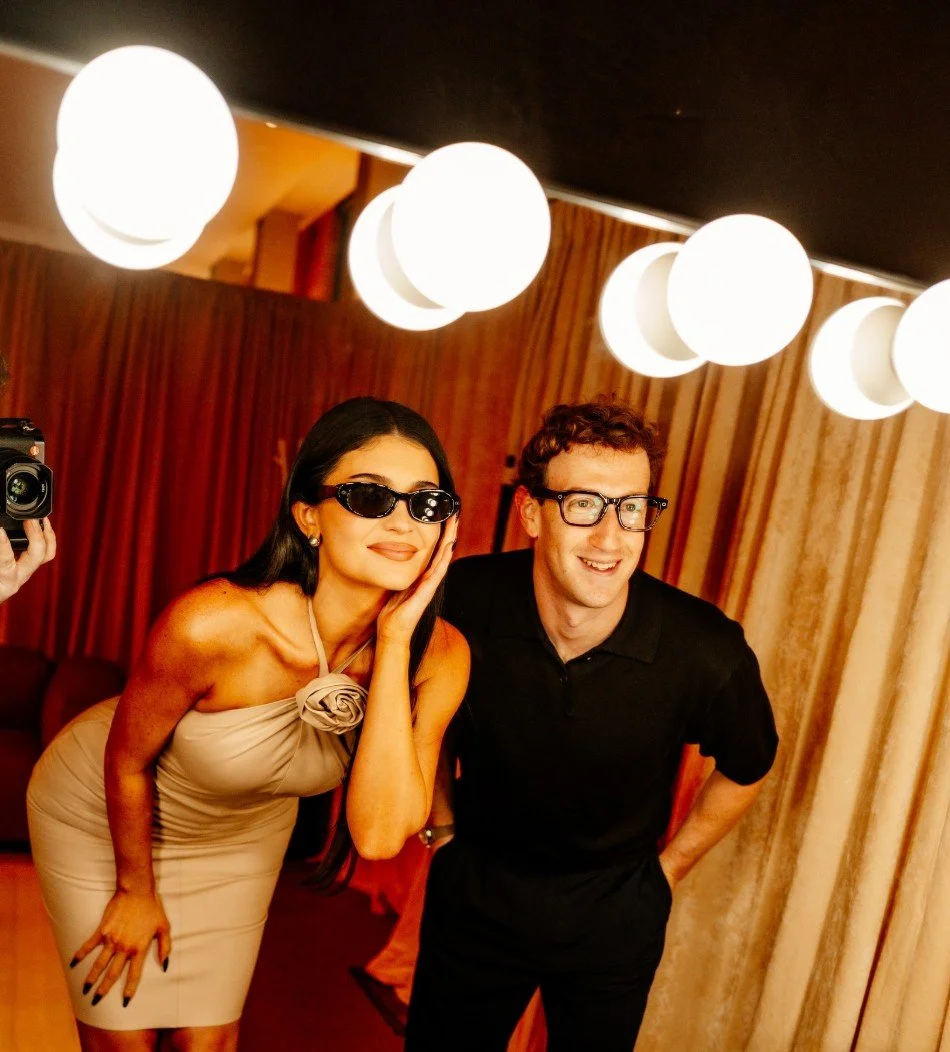
Meta smart glasses launch: Kylie Jenner and Mark Zuckeberg.
The glasses themselves haven't earned that comfort. Reporting from the BBC this January documented men secretly filming women in public using Meta's smart glasses, then posting the footage for an audience, in one case racking up 1.3 million views on TikTok of a woman who had no idea she'd been recorded, followed by targeted harassment once the clip spread. Wired reported that Meta had quietly installed a facial recognition tool called NameTag, capable of identifying a stranger's name on sight, onto more than 50 million devices before ever announcing it publicly. The company pulled the feature after the story broke, which says less about Meta's caution and more about how far something can travel before anyone outside the company notices.

Meta Glasses by Kylie, a $399 slim oval frame she says she helped design. Her voice is built into the onboard AI assistant.
Meta's own safety response amounts to a warning against wearing the glasses in locker rooms and a recording indicator light that multiple outlets note is trivially easy to obscure. When Meta's CTO Andrew Bosworth was pressed on the privacy concerns this year, his answer reached for nostalgia rather than a fix: "I'm old enough to remember when there was controversy about phones having cameras. So there is this social learning thing that has to happen." It's a comparison that treats a documented harassment pattern as a growing pain rather than a design flaw.
Hiring Jenner doesn't change any of that engineering. What it changes is how the product feels to hold. She is, by a wide margin, one of the most trusted faces in the world for making an aspirational object feel safe to want. That's the actual transaction here, not glasses getting better, but glasses getting a face attached to them that makes scrutiny feel unfashionable to bring up.
The financial backdrop makes the stakes of that transaction clearer. Reality Labs, the Meta division building all of this, lost more than $4 billion in the first quarter of 2026 alone, on just $402 million in revenue. Cumulative losses since 2020 have crossed $83 billion. Full year 2025 losses landed at $19.1 billion, roughly flat with the year before, and Zuckerberg has told investors to expect 2026 to look similar, framing it as the peak before losses start coming down.

Mark Zuckeberg says he spent years working on Meta Glasses.
Despite that, Meta is raising its 2026 capital expenditure guidance to somewhere between $125 and $145 billion, most of it aimed at AI infrastructure. Smart glasses are the one part of Reality Labs actually working inside all that red ink, sales tripling year over year, Meta now holding somewhere between 73 and 80 percent of the global smart glasses market depending on whose count you trust. The Kylie collaboration isn't rescuing a failing category. It's expanding the only piece of a multibillion dollar money pit that's currently paying its way.
Which means this launch is doing real work for Zuckerberg beyond selling frames. Meta stock is down double digits over the past year, and Wall Street has been openly skeptical of the AI spending. A culturally fluent, headline generating collaboration is worth something to sentiment that has nothing to do with units sold.
There's a version of this story that ends here, a savvy financial and reputational play, executed by two people who understand attention better than almost anyone alive. But the more interesting question is what happens once glasses like these become as unremarkable as phones, and what that means for anyone standing in a gallery or a museum, trying to look at something without a device, or an assistant, standing between them and it. That's a bigger conversation than this piece has room for. More on that next week.