Marc Glimcher called the gallery model unfixable. He's right. Even if he helped break it.
By Aleksandra DiniC · June 10th 2026 · 6 min read
Marc Glimcher, Pace Gallery.
Nobody panic. Or do. But read this first.
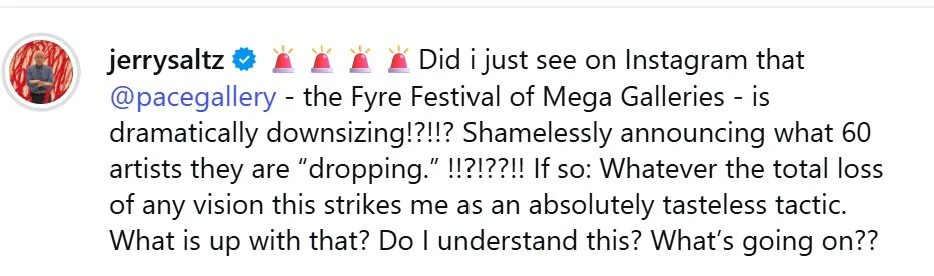
On Wednesday night the New York Times reported that Pace Gallery — one of the most powerful commercial galleries in the world — was cutting 50 artists from its roster of 135 and laying off 50 of its 250 staff. By Thursday morning Jerry Saltz, Pulitzer Prize-winning critic and Instagram's most reliably passionate responder, had posted his verdict: Pace was "the Fyre Festival of Mega Galleries," the cuts were "shamelessly" announced, and the whole thing was "an absolutely tasteless tactic."
With respect to Saltz, who has been calling out Pace's megalomaniac Chelsea transformation for years and is not entirely wrong about the feeling of it — his "Fyre Festival of Mega Galleries" verdict lands because it has history behind it, and I am sure we will hear a bigger argument too. But the tastelessness we all like to react to is a symptom. The disease is something far louder and far more urgent — artistic tastelessness. The kind dressed up as vision, curated into blue-chip legitimacy, and warehoused in an eight-story building on West 25th Street until the market finally says enough.
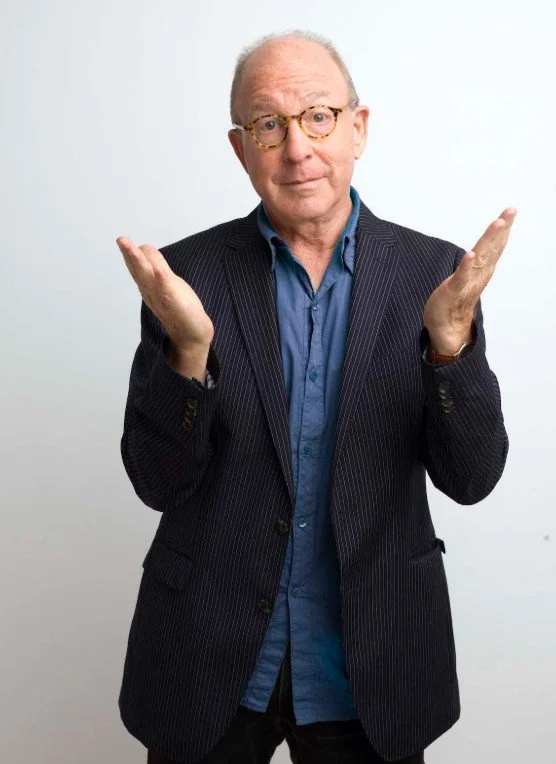
Jerry Saltz, art critic.
Sure, Marc Glimcher's statement was blunt in the way that people are only blunt when they've been privately saying something for years, or when the balance sheet tells them to: "The art world has changed dramatically over the past decade, and the current gallery model isn't only broken, it's unfixable. Every gallery is currently making temporary fixes and compromises to prop up a system that no longer works."
He's right. He's also the person who built the system he's now dismantling — which matters, shouldn't be glossed over, and shouldn't be screamed about like he's the only one in the industry who overextended, overpromised, and overcrowded the walls.
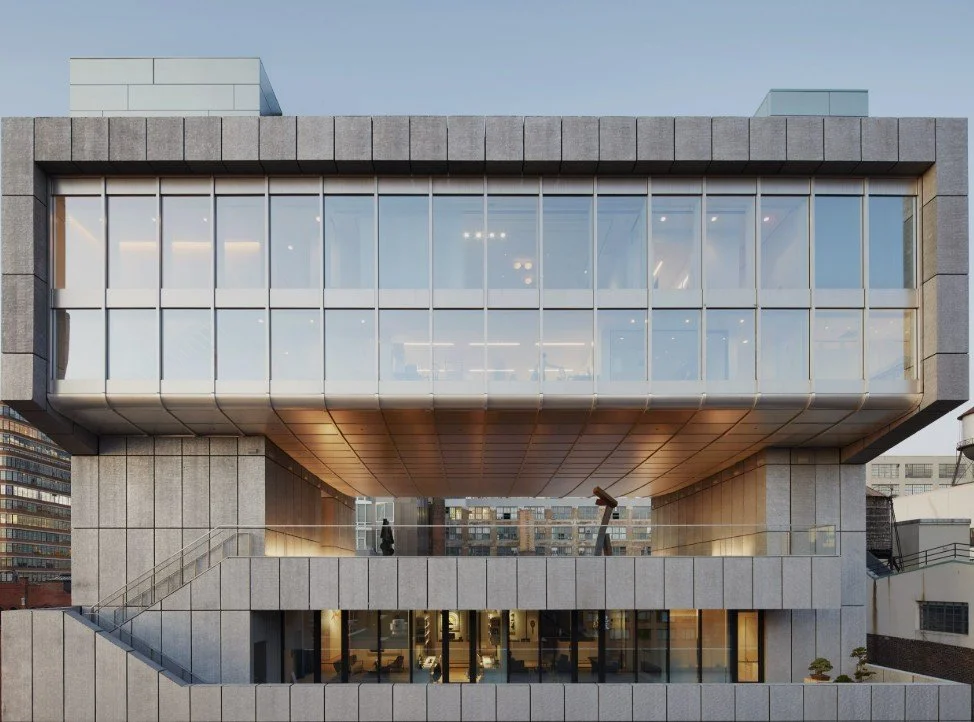
Pace Gallery, 540 West 25th Street, Chelsea, New York.
Pace renovated its eight-story Chelsea flagship in 2019 for over $100 million, carrying approximately $9 million in annual rent on a 20-year lease. Then came Pace Verso, their NFT platform, launched in 2021 at the peak of speculative fever. Then Superblue, an immersive art venture co-founded by Glimcher that opened a London space and closed it after a single show — Miami remains open, but Glimcher has since exited the venture entirely. Marc Glimcher likes to overextend. That is not a secret in this industry. Of the Chelsea building he told the New York Times: "If I were making that decision today, by no means would this be my decision. But that is not how business works. You don't get to go back and restart. You have to adapt continuously."
Fair enough. He made the mess. He is also cleaning it up. Both things are true.
Here is what a roster of 135 artists actually means in practice: most of them are not getting shows. The gallery's curatorial identity is so diluted that no coherent vision is possible. Artists are being warehoused — listed, credentialed, present on a website — while the gallery's actual attention goes to the twenty names moving at auction. A roster of 135 is not representation. It is a storage facility with good lighting. Many of those artists are also tech and installation artists who in many instances do not generate revenue and require high costs for the maintenance of their work.
Glimcher admitted it himself: rosters that large make it "virtually impossible to give all of the artists the level of support that they deserve and virtually impossible to have a programme that presents a strategic, unified vision."
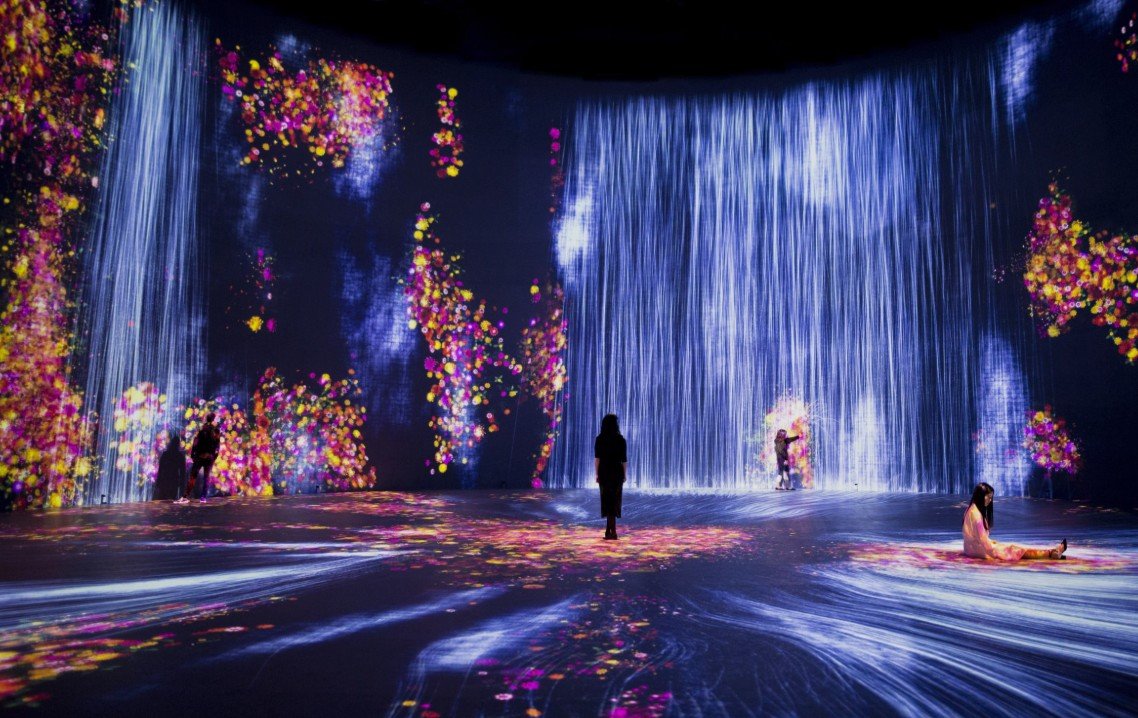
Superblue, Miami
The mega-gallery model didn't collapse because the market crashed. The top of the market is doing fine — a Pollock sold for $181 million in May, auction week in New York totaled over a billion dollars, Art Basel has been strong. What failed is the logic that bigger is better, that more artists means more vision, that a gallery can represent 135 people and still have a curatorial identity worth defending.
The mid-tier market has been soft for years. But that softness is not random bad luck. It is the market's verdict on work that was chosen for its narrative, its timing, its auction potential, its trend alignment. Not its quality. Not its vision. Galleries built rosters around the wrong criteria and the market eventually caught up. That is not a financial crisis. That is an aesthetic reckoning.
And here is the thing about markets — financial markets, art markets, any market. They are living things. They feel pressure, they feel success, they feel the weight of accumulated bad decisions and global events. They will correct themselves with or without human intervention, whether the people in charge are ready or not. What we are watching at Pace is a correction that the aesthetic argument should have triggered a decade ago but didn't. The market got there eventually. It always does.
If a smaller gallery had done exactly this — cut its roster by 30%, admitted the model wasn't working, tried to return to a focused curatorial vision — nobody would have blinked. It would have been a quiet Tuesday in the trade press. Because Pace is blue-chip, because the scale is large, because Marc Glimcher said "unfixable" out loud in a press statement, it became a moral crisis. It isn't. It's a business decision that should have been made sooner, by more galleries, with less drama.
The full list has not been officially published, but word is that some of them include teamLab, Glenn Kaino, Drift, and the Avedon estate — names with established markets and institutional presence that will land on their feet.
But here is what nobody is talking about: the opportunity this creates.
Hauser & Wirth has already quietly built a model for what comes next. They call it Collective Impact — a formal co-representation structure in which a mega-gallery partners with a smaller gallery and splits commissions evenly, 50/50. Not a token percentage while the bigger gallery takes the credit. An actual partnership. The idea, according to Hauser & Wirth president Marc Payot, came up during the pandemic "when the gap between larger galleries and the rest of the ecosystem got bigger." That gap has not gotten smaller. It has become structural.
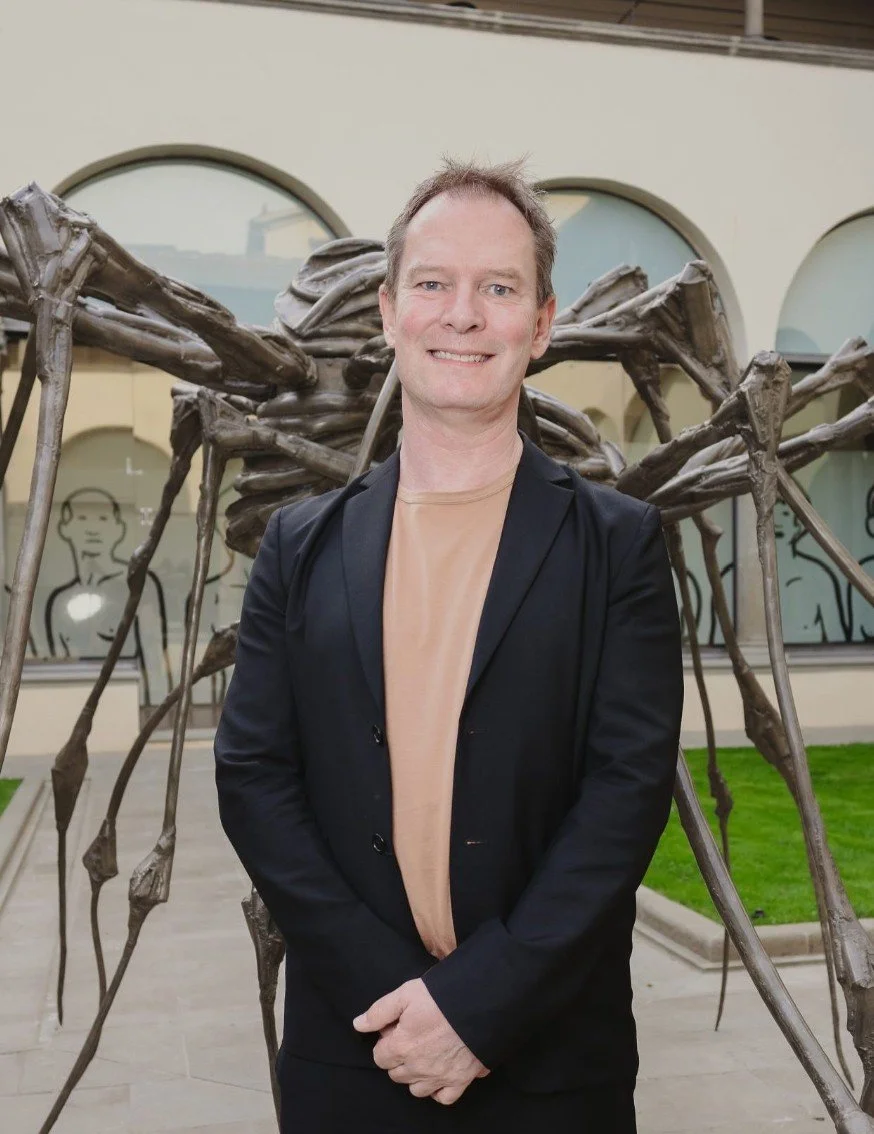
Marc Payot, President, Hauser & Wirth. Photo courtesy Hauser & Wirth.
The artists Pace is releasing don't disappear. They go somewhere — to smaller galleries that will give them actual attention, actual shows, actual curatorial investment. As Richard Beavers of his eponymous Brooklyn gallery has put it, smaller galleries function as "incubator-type galleries" — doing the early career work that blue-chip operations don't have time for, building markets that bigger galleries later inherit. The model that should emerge from this moment is not a smaller version of the broken thing. It is something closer to what Hauser & Wirth is testing: mega-galleries as infrastructure, smaller galleries as curatorial intelligence, artists moving between both with transparency and shared economics.
What I hope comes out the other side is something more colorful, more genuinely creative, and more honestly artistic than what the mega-gallery era produced. Less work chosen because it fits a collector's narrative. Less work made to photograph well in a fair booth. Less flower painting. More art that couldn't have been made by anyone else.
Markets correct themselves. The art world is no exception. It just takes longer because everyone in it gets a little emotional, a little selfish, a little egocentric. Everyone believes they deserve better. Everyone finds a higher moral standard to hide behind or a virtue to signal when the numbers don't go their way. Jerry Saltz calling it tasteless is the art world doing what the art world does — reaching for the ethical argument when the business argument is the one that actually explains what happened.
But at the end of the day, if you are going to be an artist, you have to understand that the art market is a market. It is not a children's playground. It has corrections. It has consequences. And occasionally, when enough bad decisions accumulate for long enough, it has a Thursday morning where fifty names disappear from a website and everyone acts surprised.
Anarchy Daily · anarchy-daily.com