Elnara Nasirli Wants You to Hear a Tree: “Whispering Forest” from Venice to Berlin
The insanely cool Azerbaijani artist on bioelectrical sound, her grandfather's mulberry tree, and an immersive artificial lung at Burning Man that attracted visitors from all over the world.

Artist Elnara Nasirli. Picture by Oktay Jaffer
Elnara Nasirli is hard to keep up with. She might whisper, but her installations have been blasting across Europe all year. In May, she brought “Whispering Forest” to the Venice Biennale, where visitors pressed against bark-wrapped transducers and felt a tree's bioelectrical signals travel through their own bones before they consciously heard anything. All that took place a little further from the loudness of the Giardini, on the quiet, elongated shadow island of Giudecca, inside the spectacular former Church of Santi Cosma e Damiano. Effortlessly perfect, perhaps a preview of what would come next at one of Berlin's most loved summer festivals. She and her collaborator MXNZM installed Synth-ESYS (SE-01) at Berlin's Sanctum of Sound, a new site-specific piece for the festival's MaHalla program built from exposed conduits, a technological root structure, and a custom Light Synth system that turns archived plant data into pulses of light. We caught up with Nasirli soon after.
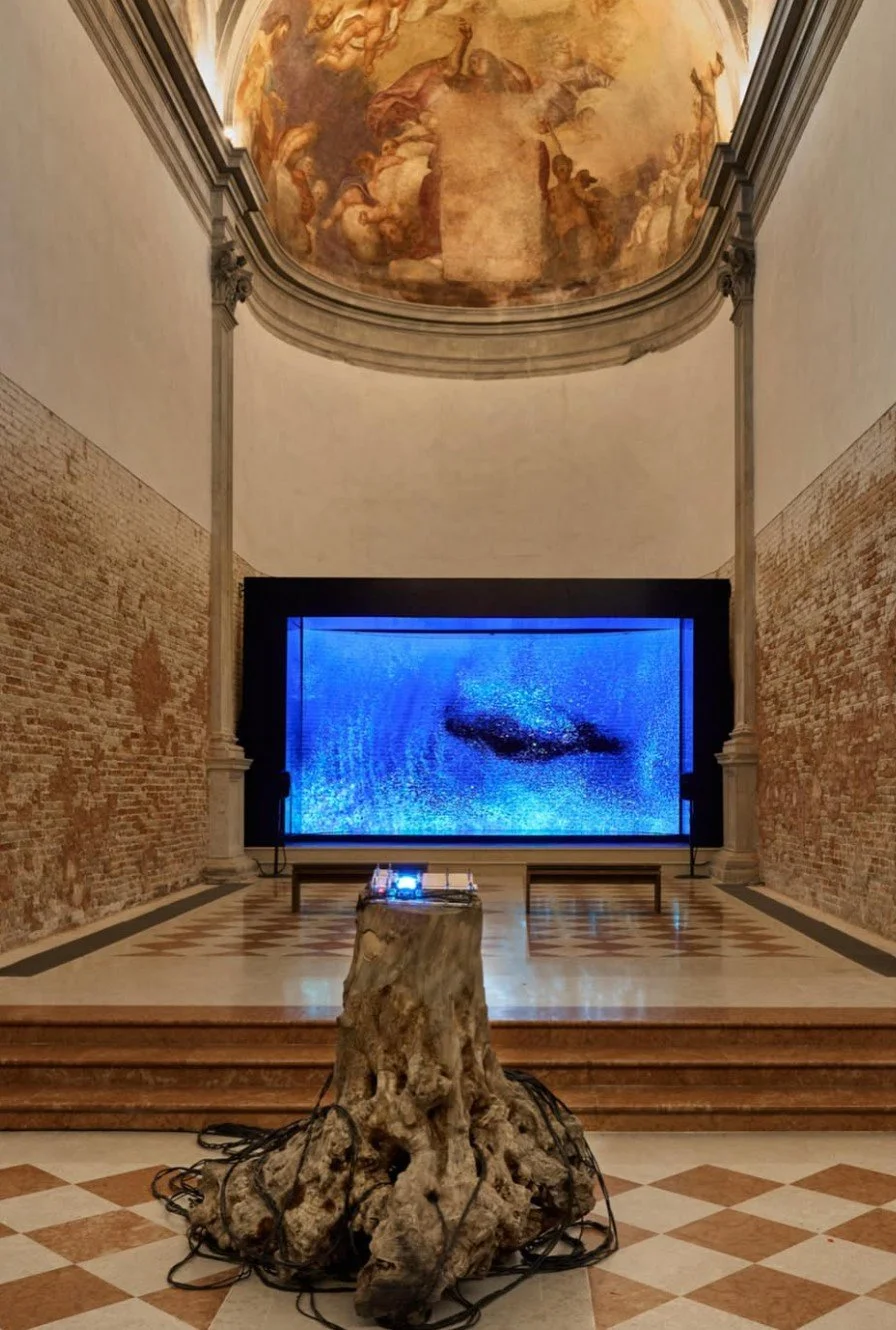
Elnara Nasirli, Whispering Forest, As Above, So Below, La Biennale di Venezia 2026, Ex Church Santi Cosma e Damiano, organized by One Ocean Foundation. Image by Clelia Cadamuro.
The Baku born artist works across biotechnology, sound, and installation now, but her path there was not a straight line. She spent 2023 painting large, color-saturated, biomorphic canvases for a Cartier-backed show in her hometown. In 2025 she was in Nevada's Black Rock Desert building an artificial lung the size of a structure people could walk into.
We asked her what she has learned about listening, why intimacy beats spectacle, and what a tree actually sounds like to her.
AD: Whispering Forest asks people to listen to a tree. What did you learn about listening while making it?
I learned that listening is not passive. It requires time, proximity, and a willingness to be changed by what you encounter. We are accustomed to listening for language or information we can immediately understand, but a tree communicates through rhythms, electrical impulses, vibration, and very slow processes. While making “Whispering Forest,” I began to think of listening less as decoding a message and more as entering a relationship. The work asks people to slow down, approach the tree, and become conscious of their own bodies. Sometimes the sound is almost inaudible and is experienced as vibration through the body. That subtlety is important because it makes the listener work a little. It reminds us that the nonhuman world has always been communicating; perhaps we have simply forgotten how to pay attention.
AD: You work across biotechnology and art. Where did those two worlds first meet for you personally?
My background is in environmental technology, but the connection became personal through my grandfather's mulberry tree in Azerbaijan. After the tree died naturally, I felt that its presence, memory, and relationship to my family had not simply disappeared. It became the conceptual beginning of Whispering Forest. Technology offered a way to translate processes that usually remain outside human perception, but art allowed me to approach them emotionally rather than only scientifically. That was the meeting point for me: not using science to explain nature, but using technological systems to create intimacy with it.
"A whisper creates a different kind of power because it asks you to come closer."
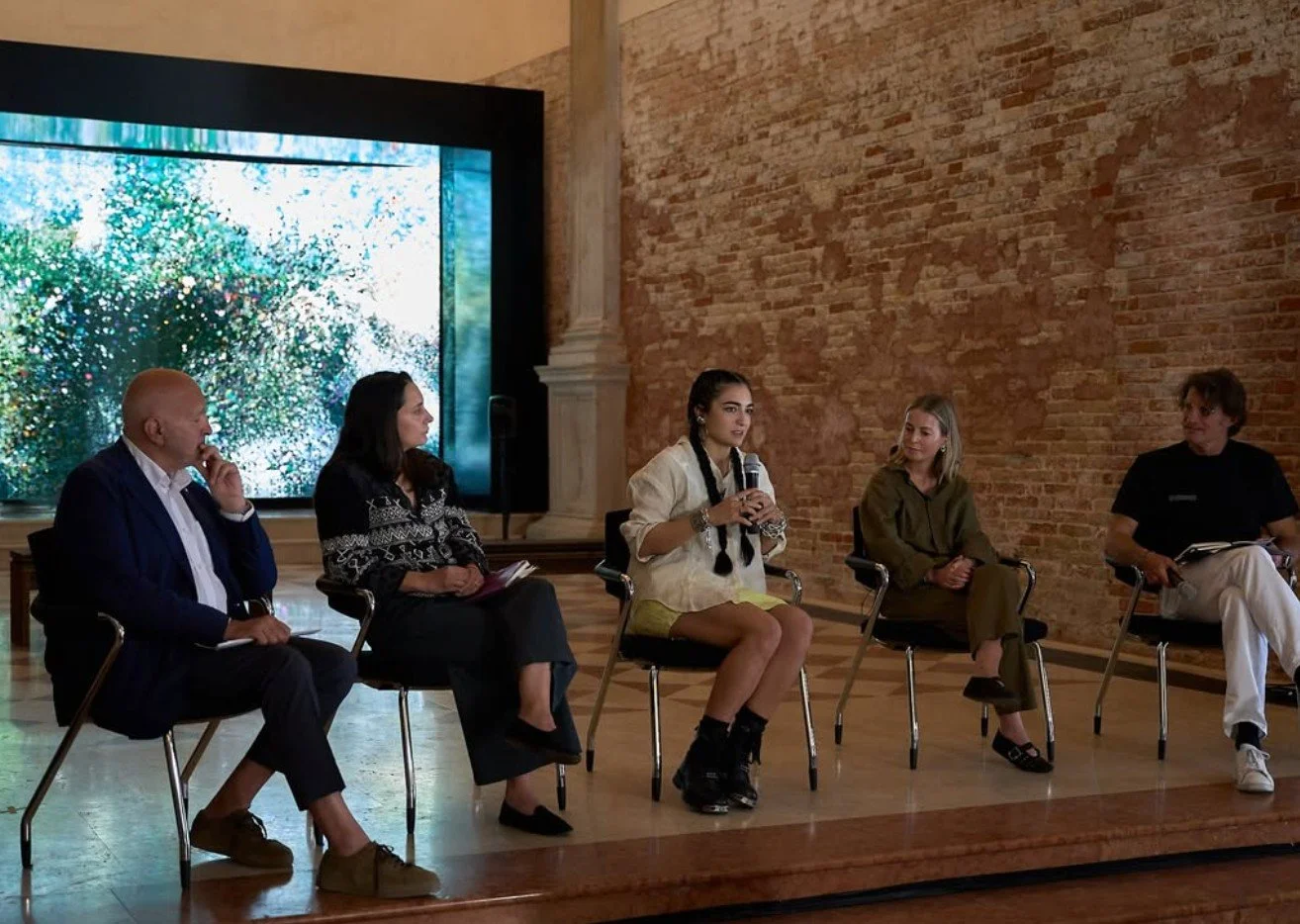
Elnara Nasirli in conversation at “As Above, So Below,” La Biennale di Venezia 2026, Ex Church Santi Cosma e Damiano, organized by One Ocean Foundation and Zeitgeist19. Courtesy of the artist.
AD: Venice is full of work making big statements. Your work whispers. Was that a deliberate choice?
Yes, completely. I did not want to compete with Venice through scale or volume. A whisper creates a different kind of power because it asks you to come closer. In a city already saturated with images, histories, and monumental gestures, I wanted to create a moment of intimacy and concentration.
The quietness is also an ethical position. I do not want to pretend that I am giving the tree a human voice or speaking on its behalf. The work creates a threshold where something can be sensed without being fully translated or controlled. It asks whether an artwork can hold attention without demanding it, and whether softness can remain present inside an environment of spectacle.
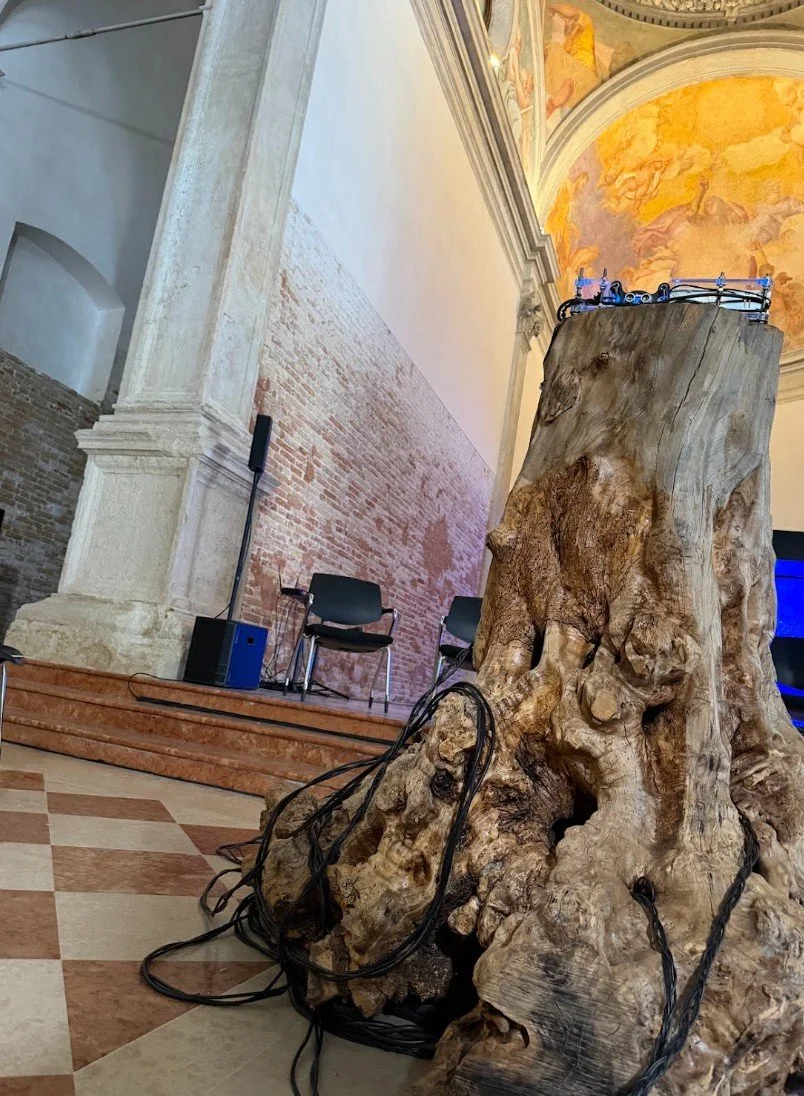
“Whispering Tree” Installation. “As Above, So Below,” La Biennale di Venezia 2026, Ex Church Santi Cosma e Damiano, organized by One Ocean Foundation.
AD: For those who never had a chance to encounter your beautiful work, what does the tree actually sound like, and what were you hoping people would feel when they heard it?
It does not sound like a conventional melody. The composition is created from plant-derived recordings and translated into layered pulses, low frequencies, irregular rhythms, and breath-like textures. Custom-made transducers and bone-conduction technology allow parts of the sound to travel through the wood, so visitors may feel the vibration through the body before consciously hearing it. It is not the tree's literal voice in real time. It is an artistic translation of vegetal signals and archived plant material.
I wanted the encounter to feel both unfamiliar and strangely intimate. Ideally, the visitor becomes aware of another living timescale and briefly feels that the boundary between their body and the forest is less fixed than they imagined.
AD: Shortly after you showed at Sanctum of Sound in Berlin, a festival built entirely around deep listening. Does that feel like coming home for Whispering Forest, or is it a different kind of listening? And could you introduce the new site-specific work?
Whispering Forest asks for an ecological form of listening, not only with the ears, but through touch, vibration, patience, and physical presence. At Sanctum of Sound, that encounter sits within a much wider culture of sonic attention.
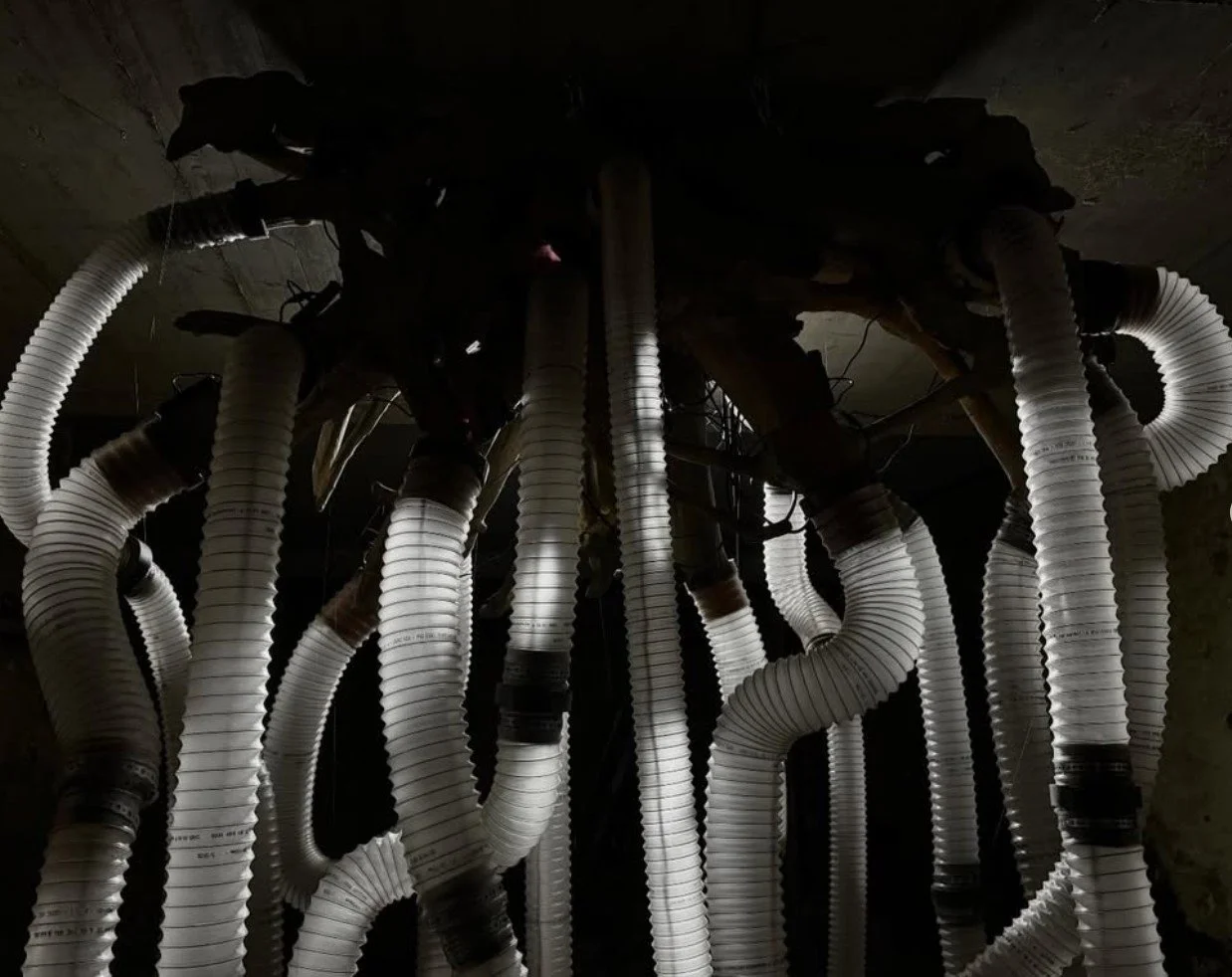
For MaHalla, MXNZM and I created a new site-specific work titled Synth-ESYS (SE-01). It imagines the installation as one visible section of a much larger distributed system of ecological intelligence. A technological root structure, exposed conduits, and archived bioelectrical recordings suggest an organic data infrastructure extending beyond Berlin to future nodes in other landscapes. Through our custom-built Light Synth system, plant-derived datasets are translated into evolving pulses of light. The work functions simultaneously as an archive, a transmitter, and an interface, a place where signals once produced by living trees return as light, rhythm, and spatial memory.
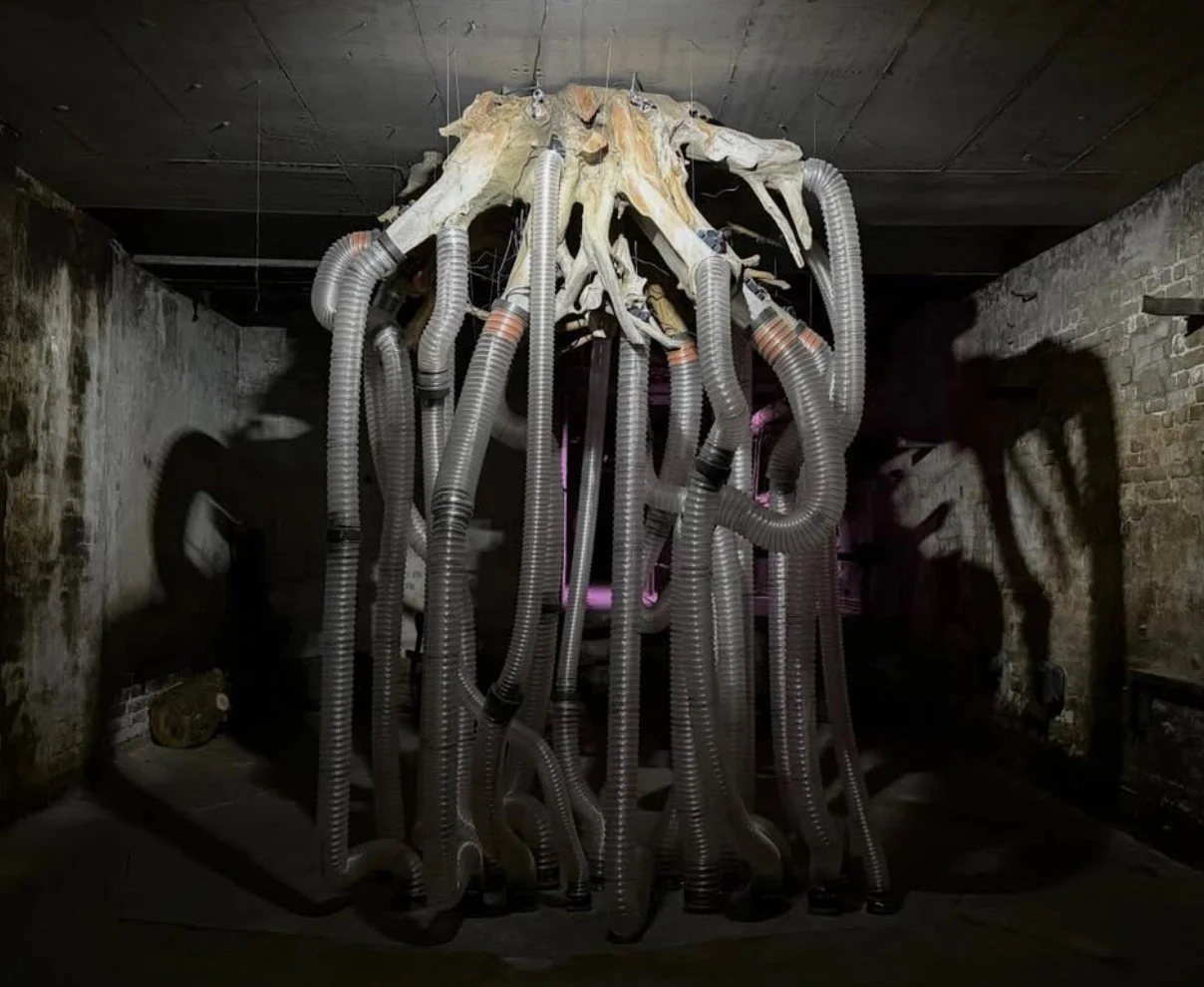
Site specific immersive installation for “Sanctum of Sound 2026” at MaHalla Berlin. Elnara Nasirli X MXNZM
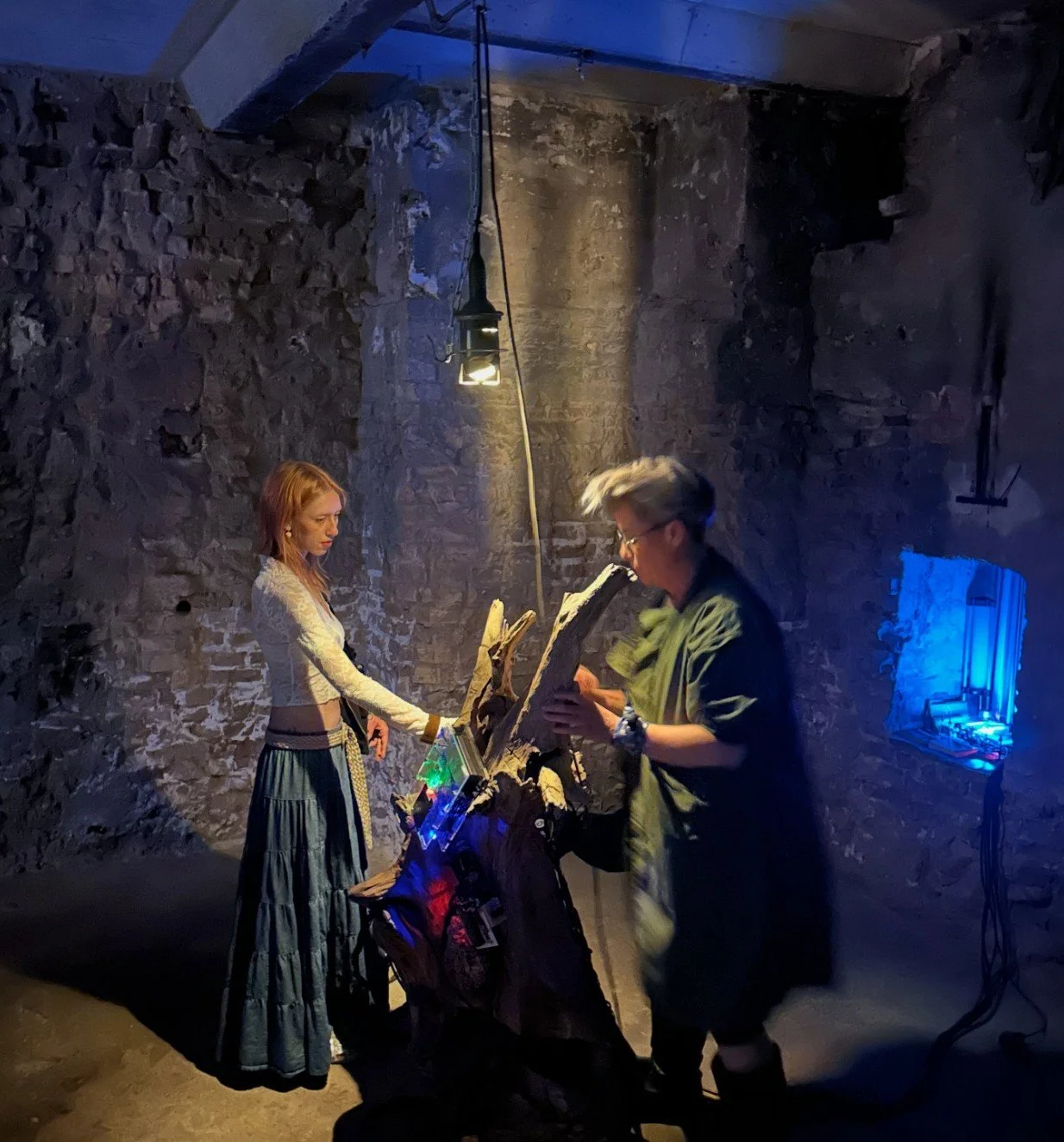
“Whispering Forest,” experienced during MaHalla, Berlin 2026
AD: You collaborated with Cartier on its "Culture of Design" exhibition in Baku, if I'm not mistaken. What was it like and what was the collaboration about?
Yes, I took part in “The Culture of Design,” presented by Cartier at Gazelli Art House Baku in 2023. At that time, my practice looked quite different. I was creating large-scale paintings filled with intense color, movement, and biomorphic forms. The collaboration was therefore less connected to biotechnology or reclaimed materials and more to the visual energy of the work.

Elnara Nasirli, 2023, during “The Culture of Design,” presented by Cartier at Gazelli Art House Baku. Courtesy of the artist.
I think Cartier was interested in the relationship between color, form, craftsmanship, and transformation. Although my practice has since evolved toward ecological systems, sound, and technology, those paintings were already concerned with organic structures and the emotional effect of color. I am still exploring living forms, but today they have expanded beyond the surface of the painting and into installation, sound, and responsive environments.
AD: You mentioned that you were in the United States last year. What were you doing there, and what was the most exciting part?
In 2025, I was in the United States to build Desert Air Oasis: BreathCore-7 at Burning Man in Nevada's Black Rock Desert and at Reno Art Fair. It was a large-scale immersive installation imagining a dystopian future in which natural plant life has disappeared and breathable air has become a controlled resource. The central structure functioned like an artificial lung, surrounded by an architectural shell that visitors could enter and experience.
The most exciting part was seeing a speculative idea become a real physical environment under extremely demanding conditions. But the most rewarding moment was when people entered the work and began interacting with it. It stopped belonging only to us and became a temporary social space in which questions about breath, survival, and ecological loss could be experienced physically rather than simply discussed.
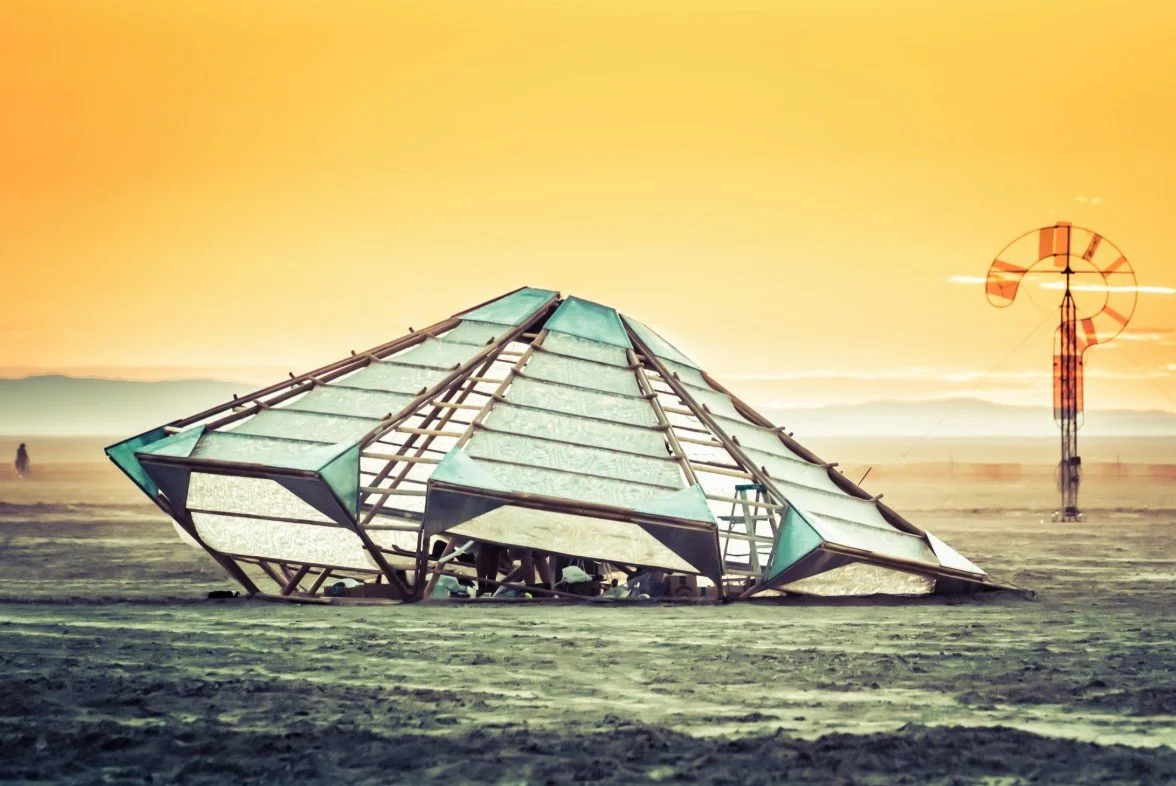
BreathCore-7, an interactive installation and sound-healing lounge at Burning Man, by lead artist Elnara Nasirli with MXNZM. Photo by Mark Fromson (@autobiographica).
AD: What are you working on next, and what question is driving it?
My practice is always moving across different forms. Alongside my installation work, I continue to develop more personal series in ceramics, painting, and mixed media. Together with MXNZM, I am also developing Synth-ESYS beyond its first Berlin node as a growing network of ecological archives, drawing from plant bioelectrical recordings collected in different forests and landscapes. At the same time, I am developing Fluxus Space, the gallery and interdisciplinary platform I founded in Baku, where we support local talent across contemporary art, theater, music, and film.
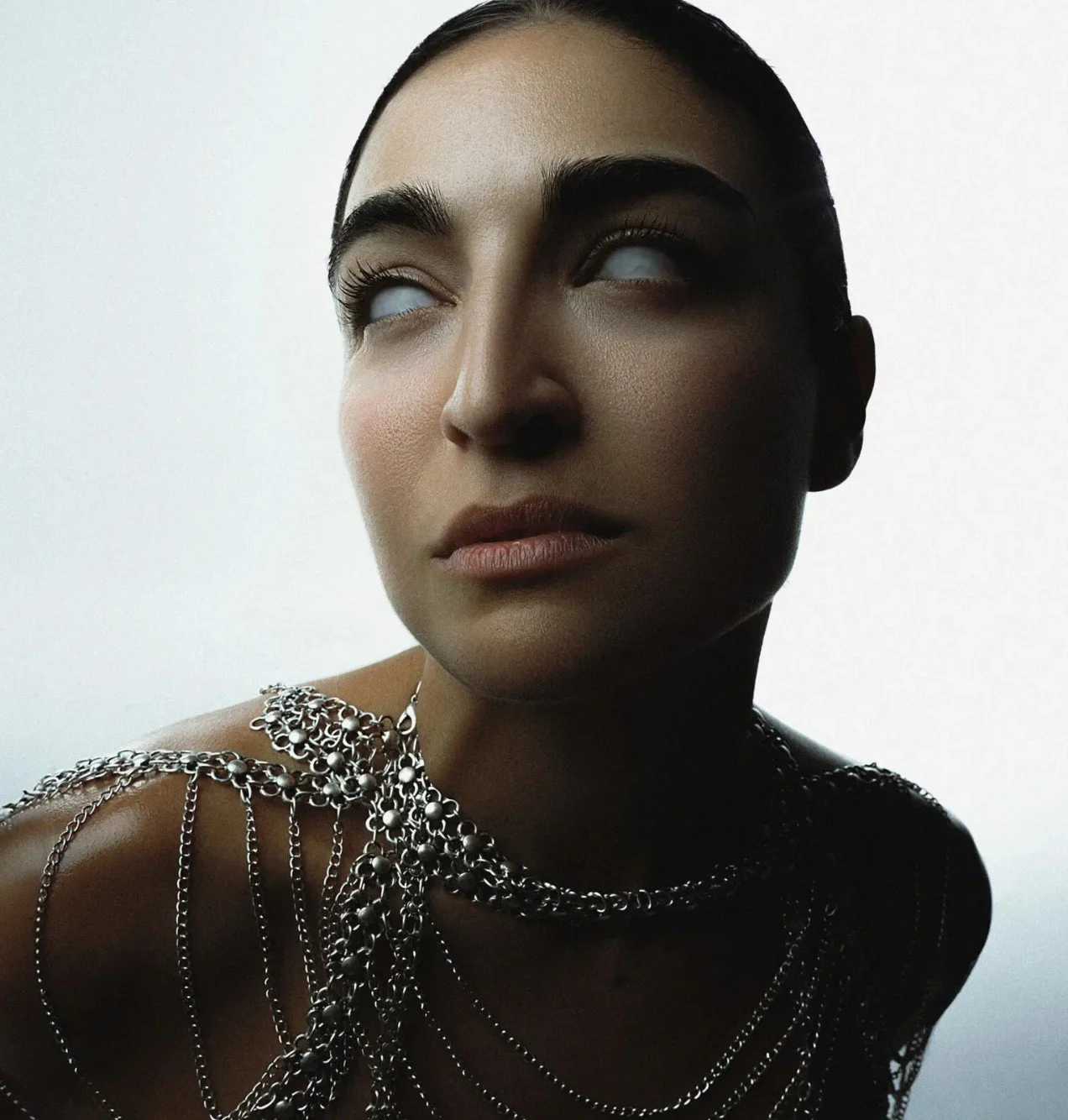
Elnara Nasirli. Picture by Oktay Jaffar.
Across all these directions, I am researching tree communication and the possibility of mechanically reconstructing aspects of climate and ecological systems within indoor environments. The central question driving this work is: can technology become a form of listening rather than extraction? I am interested in what happens when technology does not attempt to dominate, accelerate, or simplify a living system, but instead helps us encounter its complexity.