Maurizio Cattelan’s first major solo exhibition in Germany, NIGHT, brings fallen popes, fascist ghosts and institutional mischief to Berlin’s Neue Nationalgalerie.

Maurizio Cattelan at the opening of NIGHT, Neue Nationalgalerie, Berlin.
That Maurizio Cattelan is a genius is no revelation. In his uniform of self-effacing silence, he can easily be mistaken for a patient spectator—an unlikely candidate for the title of the art world’s most dangerous troublemaker. And yet, from within, he playfully detonates the entire apparatus of institutional seriousness.
Last night, just before Berlin Art Week hit full stride, Cattelan’s meteorite finally landed in the glass-and-steel temple of the Neue Nationalgalerie. Long before entering, we joined the line of art aficionados wrapped around Mies van der Rohe’s immaculate pavilion—everyone waiting to step into Cattelan’s particular brand of beautifully curated cultural avalanche.
The exhibition brings together major works from across his career, alongside new commissions conceived specifically for the iconic building. We were there for the preview and are still digesting the wittiness and wizardry of this self-taught Italian artist, who has been shaking the art world since the 1980s.
Gravity also got its own small existential crisis: dancers in Trisha Brown’s Walking on the Wall appeared to move across the museum’s glass walls, suspended in harnesses, making Mies’s transparent architecture feel suddenly unstable, alive, and almost too perfect for the ground beneath it.
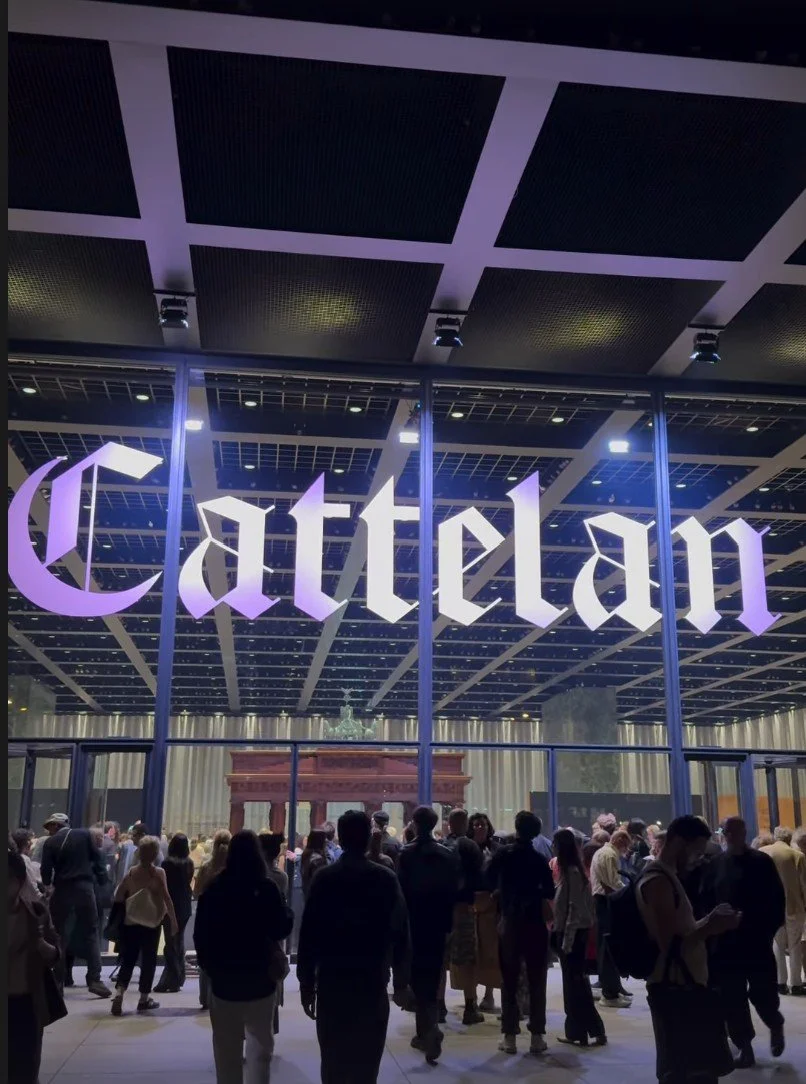
Opening night at the Neue Nationalgalerie.
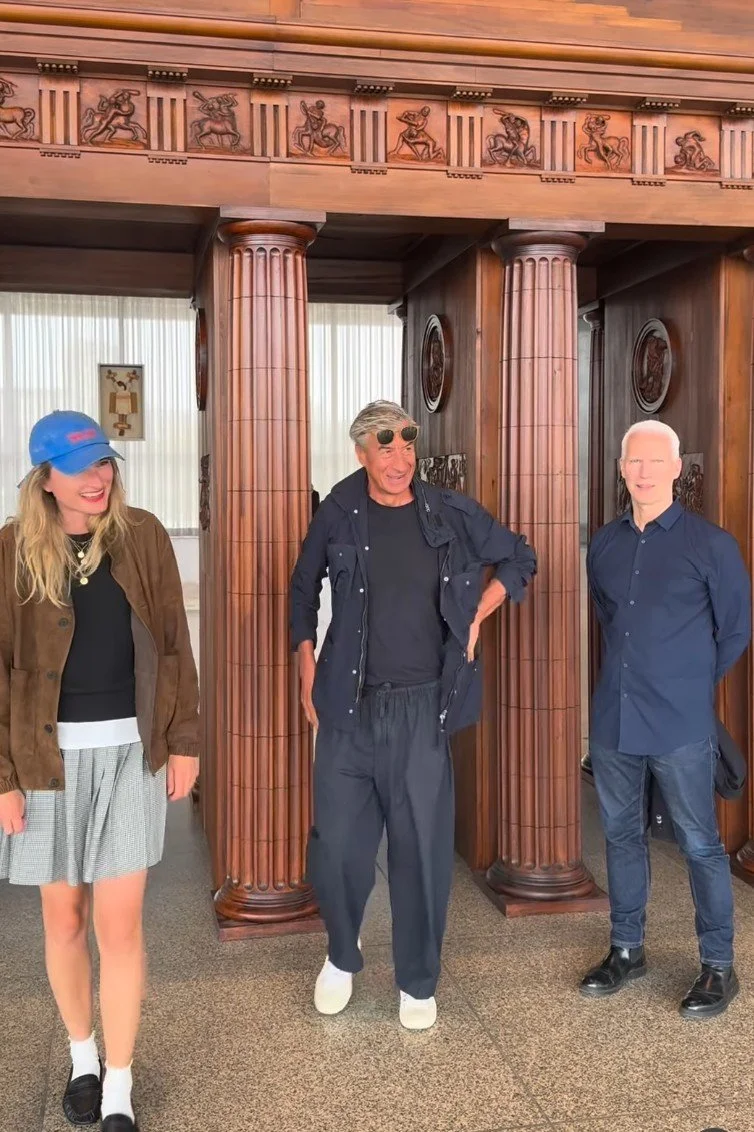
Klaus Biesenbach, Lisa Botti and Maurizio Cattelan on opening night.
Lisa Botti, curator at the Neue Nationalgalerie, working alongside museum director—and famously out-of-the-box risk-taker—Klaus Biesenbach, and in close collaboration with Cattelan himself, should be proud of the audacity it took to hand over an entire museum, and this year’s Preis der Nationalgalerie, to an artist whose career has been one long argument against taking museums too seriously.
What makes this show special is that it does not soften Cattelan for the occasion. We were tremendously unsettled—in the best possible way—by an exhibition that places La Nona Ora, the sculpture of Pope John Paul II struck down by a meteorite, in direct conversation with Him, the kneeling schoolboy wearing Hitler’s face. All of it unfolds inside a building where every wall is glass and there is nowhere for the work—or the viewer—to hide.
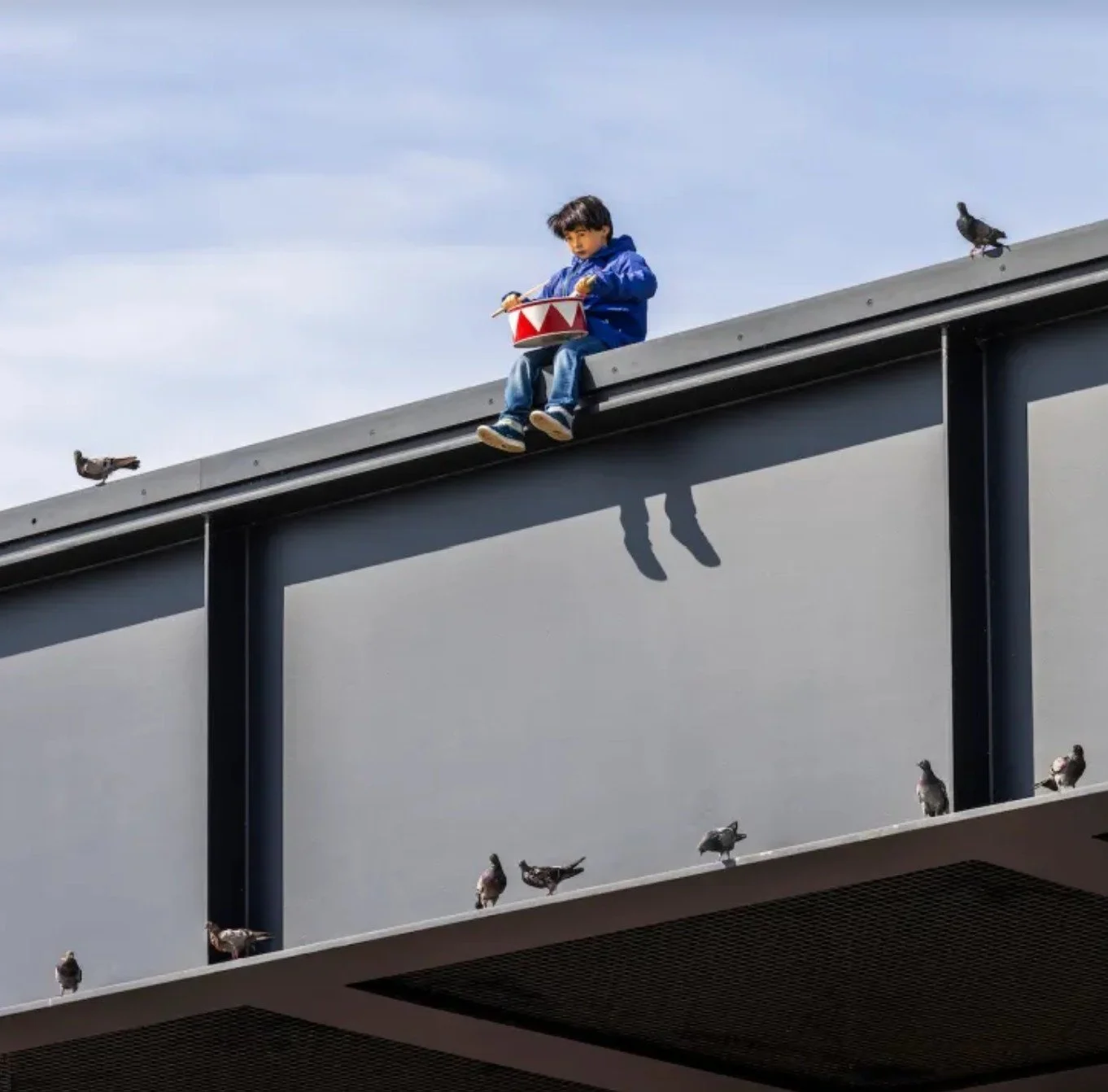
Maurizio Cattelan, Untiteled, 2003.
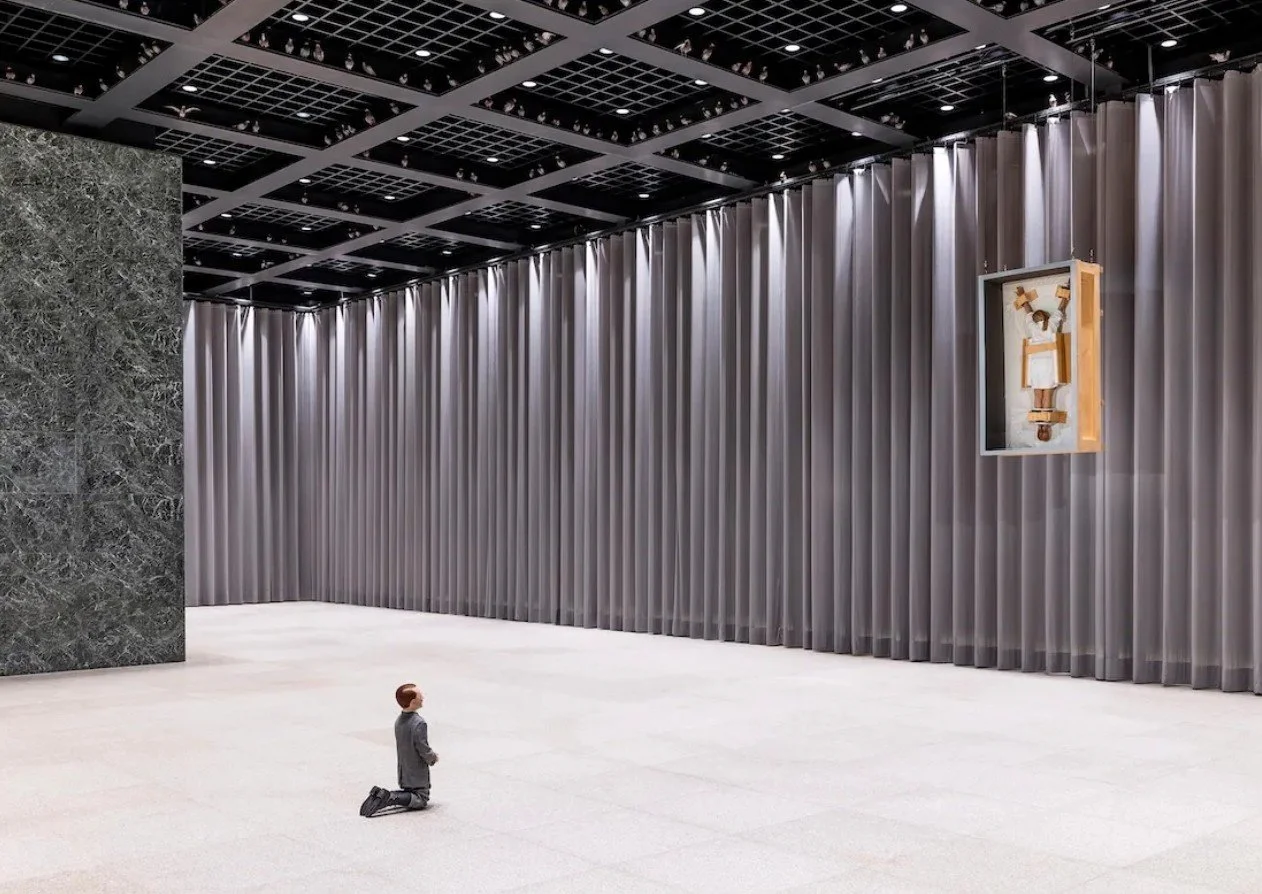
Maurizio Cattelan, Him, 2001.
Cattelan works through vacuum-formed wax, silicone, taxidermy, and animatronics: the same instinct for uncanny realism that gives Untitled, his 2003 work inspired by Günter Grass’s The Tin Drum, its particular chill. This is not shock for shock’s sake, nor provocation dressed up as concept. You can see it, feel it, sit with the discomfort these pieces generate—and perhaps be reminded of a country still working out how to look directly at its own history.
Cattelan’s practice seems to emerge not only from his peculiar biography, but from decades spent watching institutions perform virtue, memory, and authority. He does not limit himself to one medium or one register. Instead, he blends humor and grief, irony and profundity, into what critics have called comic existentialism: an arena of perfectly staged discomfort.
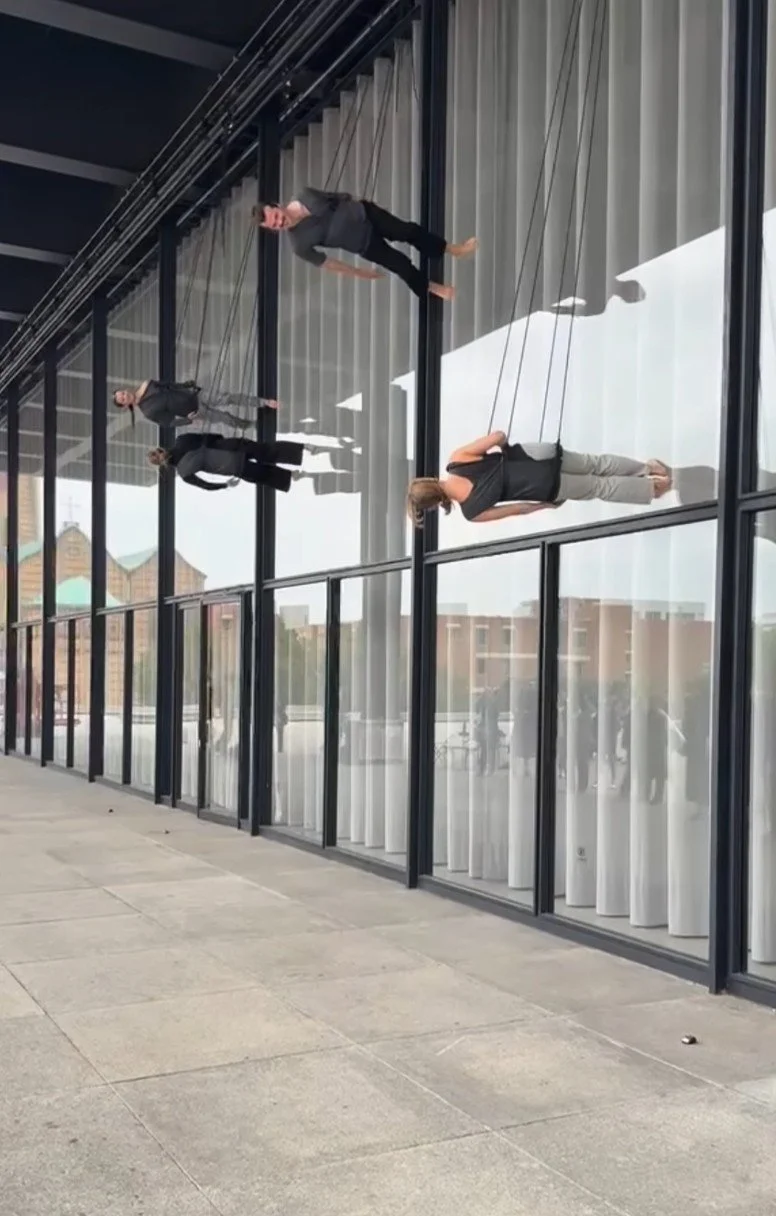
Trisha Brown’s Walking on the Wall makes gravity negotiable.
Cattelan’s reputation as one of the most consequential artists of his generation is not simply about shock value. It comes from something steadier: a career-long insistence that institutions deserve exactly as much reverence as they have earned, and no more. Twenty years after co-curating the 4th Berlin Biennale, Cattelan is back. This time, the building itself is part of the joke.
About Maurizio Cattelan
Maurizio Cattelan was born in Padua, Italy, in 1960. Since the early 1990s, he has been one of contemporary art’s defining—and most disruptive—international voices. Working across sculpture, installation, and conceptual practice, he has developed a signature language of sharp humor and bitter seriousness.
His work repeatedly confronts subjects many artists avoid: religion, childhood, authority, and collective trauma. He begins with images that feel instantly familiar, then quietly and unsettlingly shifts their meaning.
Cattelan was selected for the 2026 Preis der Nationalgalerie by an international jury that included Emma Lavigne, director of the Pinault Collection, and Sam Keller, director of the Fondation Beyeler. NIGHT, the exhibition built around that prize, marks his first major solo presentation in Germany.
NIGHT, Cattelan’s first major solo exhibition in Germany, opens to the public today, September 10, 2026, and runs through March 7, 2027.
images via Neue Nationalgalerie, Instagram and anarchy daily.