She Was Always The Director
Bianca Censori directs "Father" in a single, unbroken shot. Ye gets a song. She gets a language.
Anarchy Daily · April 2026 · 6 min read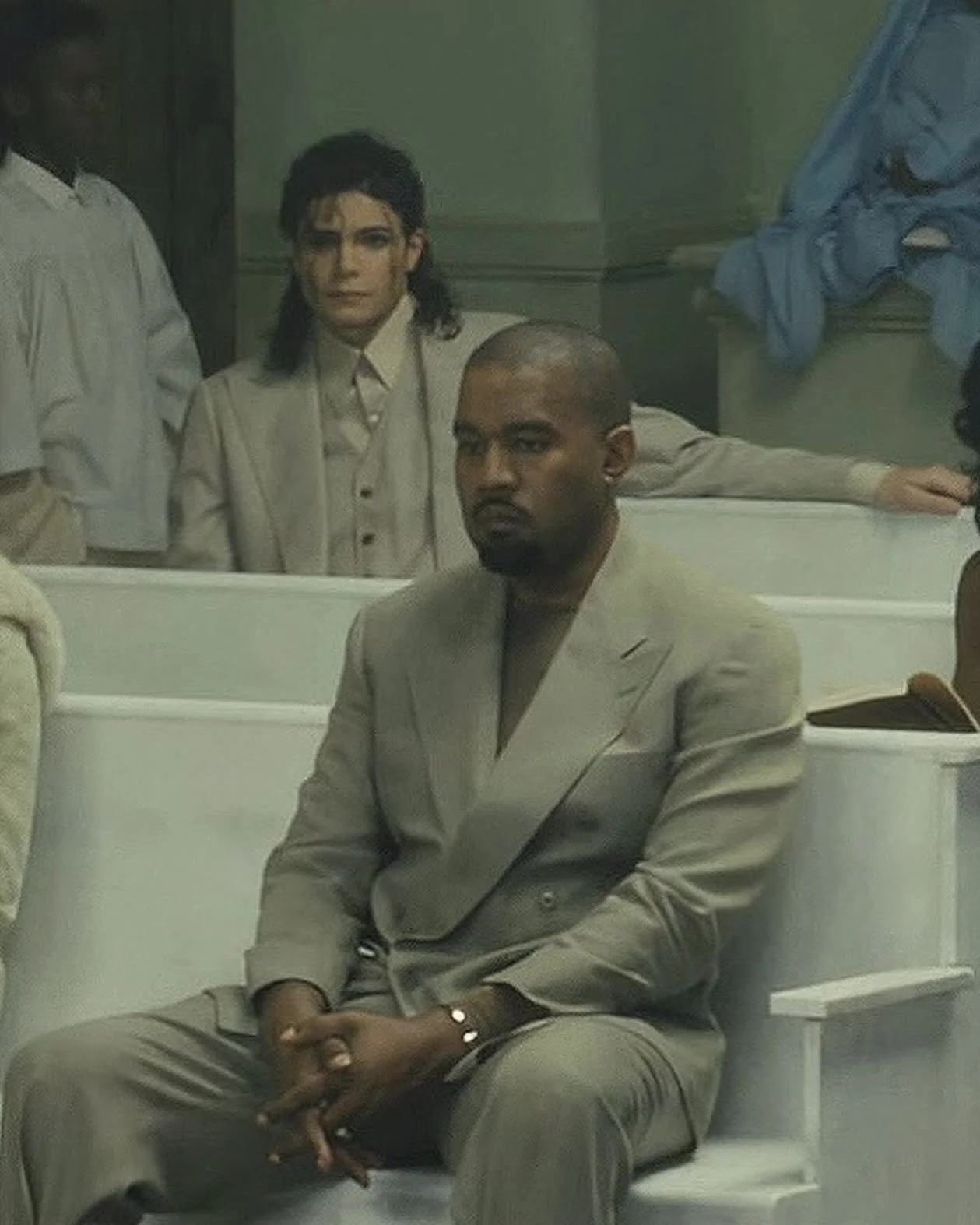
Everyone was watching Ye. That was the point, and that was the mistake. While the culture spent three years photographing his wife as an extension of his wardrobe — an aesthetic object, a muse, a projection surface — Bianca Censori was quietly building a visual grammar that just arrived, fully formed, in under three minutes.
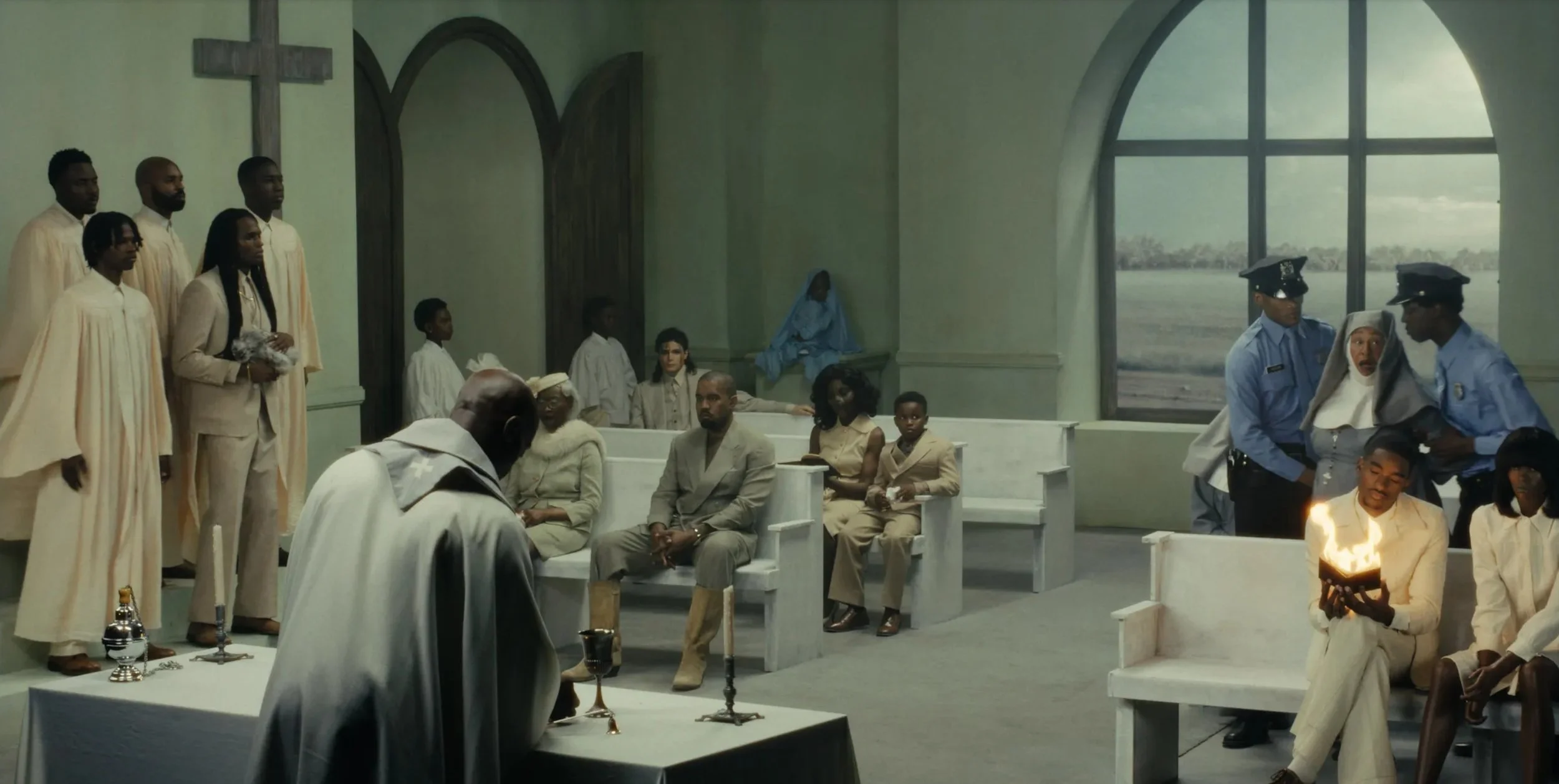
One shot, no cuts. The church in "Father" is not a location — it is a room where every century arrives at once. Dir. Bianca Censori, March 2026.
"Father," the lead single from Ye's new album “Bully,” is a collaboration with Travis Scott. It dropped March 28 alongside a music video shot in a single unbroken take, set inside a surreal church with muted tones, symbolic archetypes and a spatial logic that feels borrowed from a dream. No cuts. No edit. One continuous frame holding multiple realities at once.
Bianca Censori directed it. Her first film.
"Directing is not a departure for me, but a shift in medium. I'm still shaping space, bodies and emotion — it's just articulated through film." That line, which she gave to Architectural Digest, is the most clarifying thing said about this project. She is not a musician's wife who was given a creative toy. She is an architect who has spent years thinking about the relationship between bodies and the spaces that contain them, and she has now applied that thinking to film. The result has the compositional weight of Tarkovsky and the deadpan choreography of Tati — compressed into a track length, constrained by a single shot, and more cinematically rigorous than most full-length music videos produced this year.
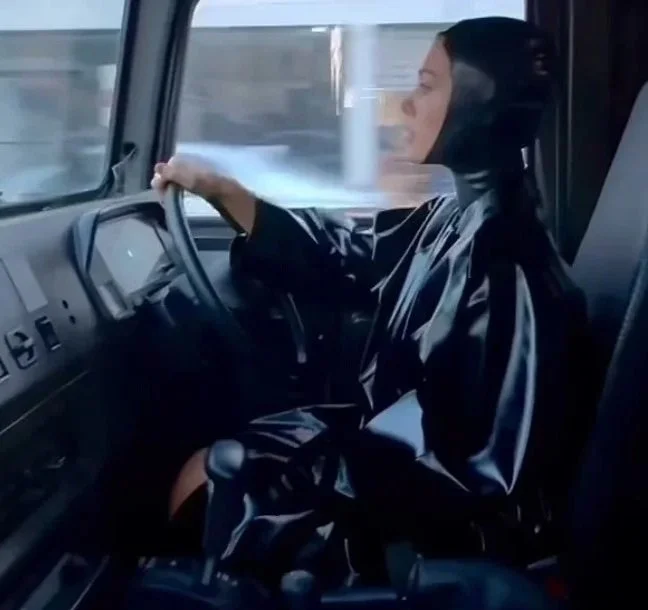
Architect. Performance artist. Director. Bianca Censori, who spent three years being photographed, has started making the images herself.
There is no detail placed for decoration. The church is not atmosphere. The figures moving through it are not extras. Each one is a precisely loaded symbol of something the present moment is failing to resolve: faith, power, innocence, spectacle, sacrifice. Censori built a room where historical archetypes from different centuries collide without resolution, because they haven't found one.
The astronauts are here alongside the armour-clad. The brides — two of them, married to Travis Scott simultaneously — stand without protest or ceremony, because that is the natural order of this world, just as it has been in many others. Some things change across centuries. Others do not. The suppression of the faithful, the innocent, the inconvenient — that is a constant that crosses every era Censori has assembled in this single room. She does not argue the point. She stages it and lets you find it.
Nothing in "Father" is accidental. Every symbol was chosen. Every figure a loaded question about what we repeat and what we refuse to name.
And then there is the unbothered quality that runs through every performance in the frame. Not one figure reacts to what surrounds them. Not one face betrays surprise or wonder. The aliens do not startle anyone. The armoured figure does not threaten anyone. Two women are married to the same man and the congregation does not flinch. This is not bad acting. This is the whole point. Social media has stripped us of mystery. The genuine surprise — the aha moment, the rupture of the expected — barely registers anymore. We encounter the extraordinary and scroll past it. Censori's cast embodies that condition with remarkable precision. Their collective unbotheredness is the film's most devastating cultural argument.
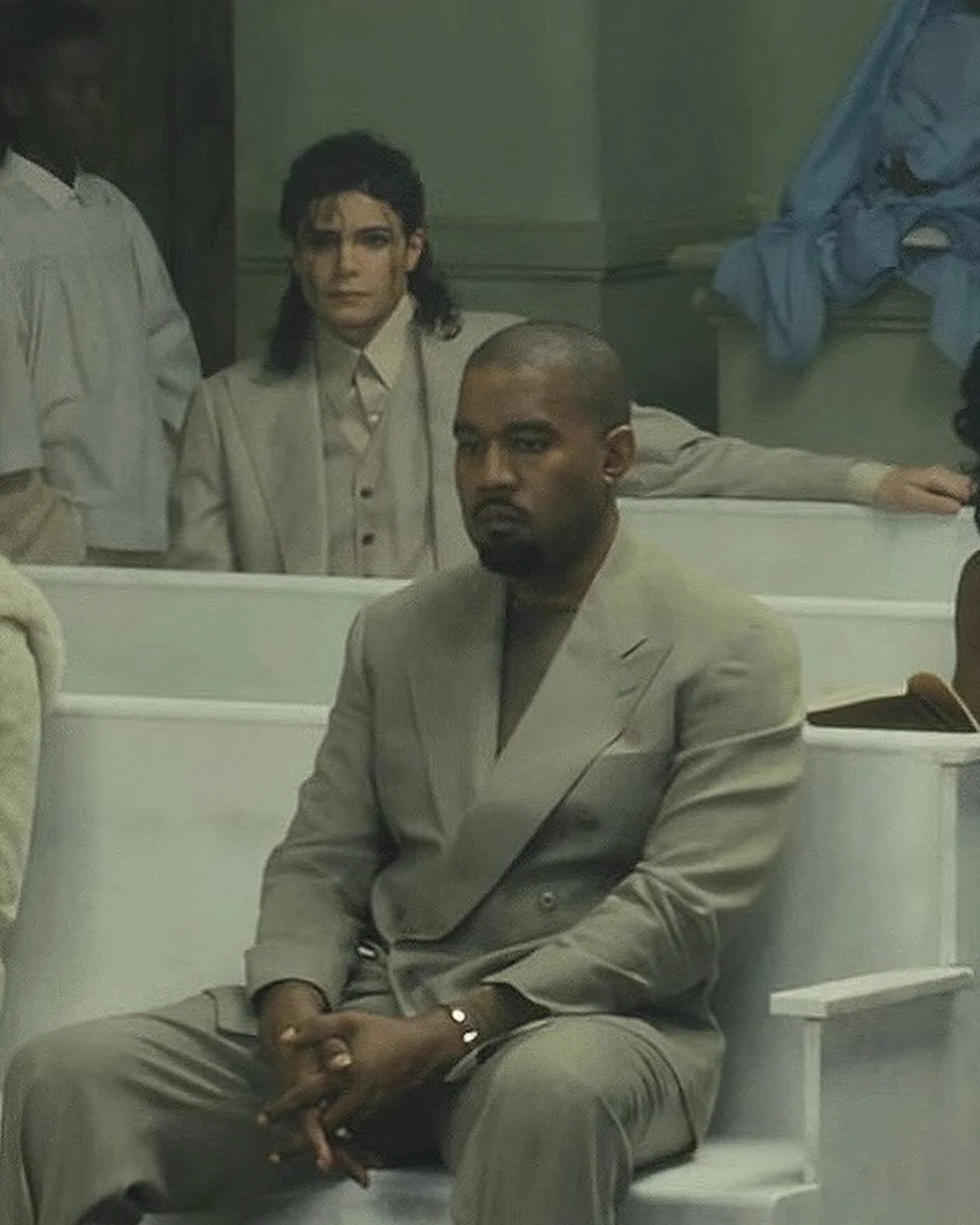
Ye sits in the pews. Present but elsewhere. His thousand-mile stare — the one that has been photographed ten thousand times — is here exactly where it should be, because the film is partly about men who are physically in the room while being spiritually absent from it. Travis Scott performs his verse with the confidence of someone who has never questioned his right to take up space.
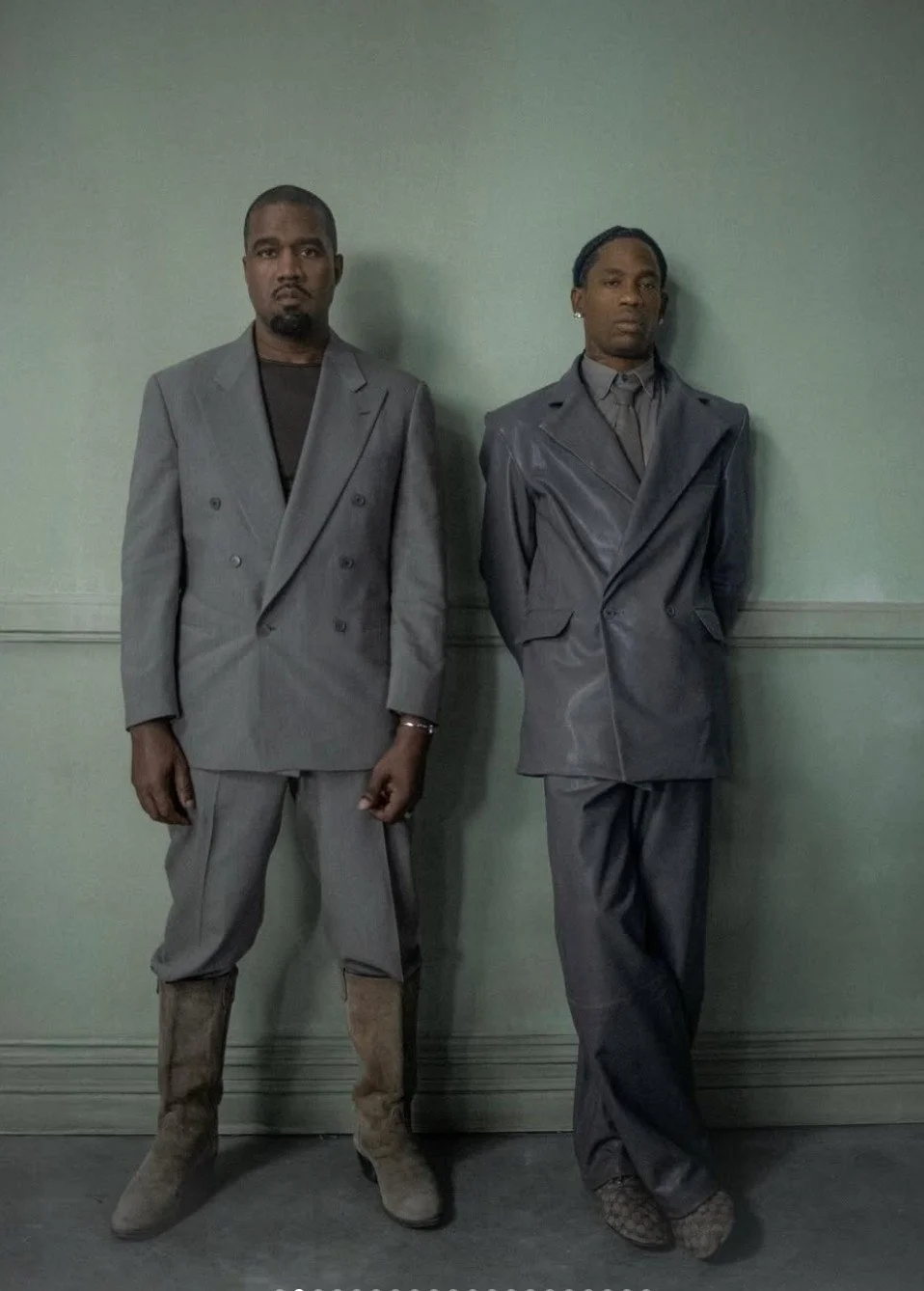
Ye and Travis Scott on set. "Father," directed by Bianca Censori. March 2026. Images courtesy of Bianca Censory by Mark Saldaña.
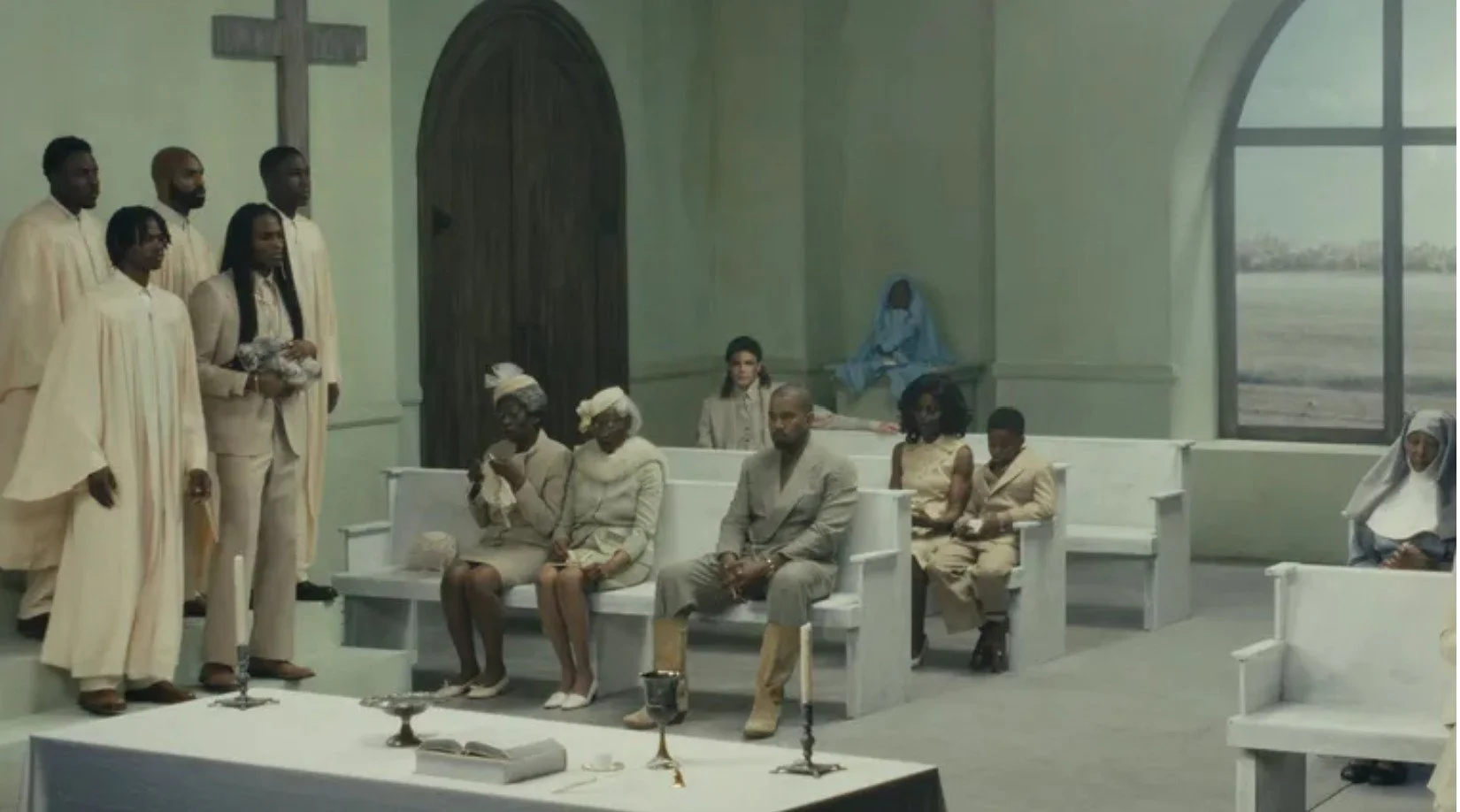
Ye in the pews. Present but elsewhere. A still from "Father," directed by Bianca Censori. March 2026.
Ye sits present but elsewhere. Travis performs with the confidence of someone who has never questioned his right to take up space. Censori makes them interchangeable. That is the film's sharpest edge.
And then, at the back of the church, pulling focus, barely, is a Michael Jackson impersonator. Fabio Jackson, the man behind the performance, called the shoot "magical." Censori placed him there deliberately, and his presence is the film's most quietly heartbreaking gesture. Jackson is the clearest symbol of what the world does to its most extraordinary: it worships, consumes, destroys, then replaces with an imitation. It adores the singular and cannot tolerate it. The impersonator in the pew is not a tribute. He is a warning. The world is often not ready for the wonderful. It has a long history of dismantling exactly what it claims to love — and then, once the damage is done, building a shrine to the version it preferred.
The Michael Jackson impersonator is not a tribute. He is a warning. The world has a long history of dismantling exactly what it claims to love.
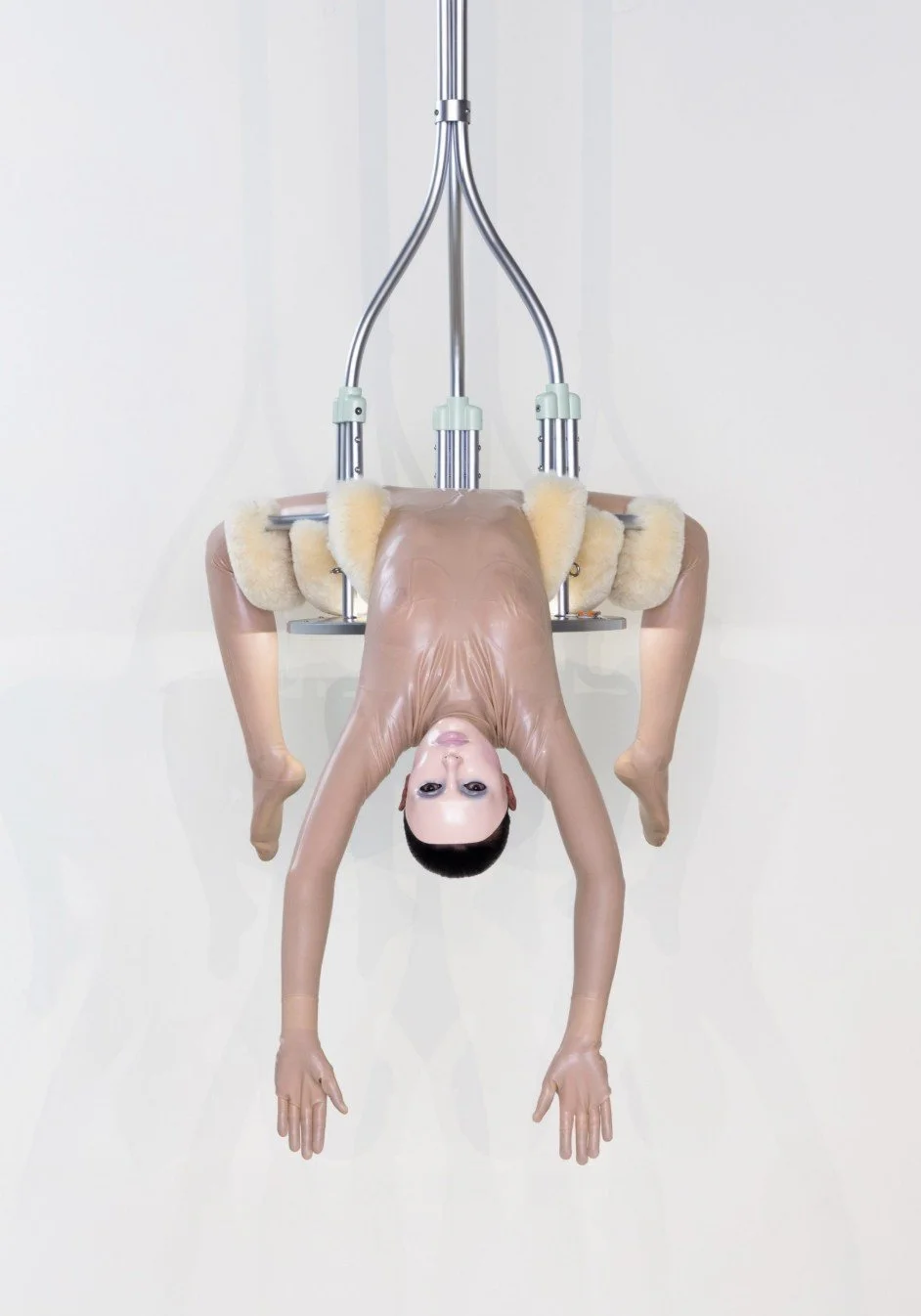
The church is not a location. That is the crucial distinction. Censori approached the blocking architecturally — arranging symbolic figures from across time and archetype not as set decoration but as a grammar. The space holds them all simultaneously, without explanation, without resolution. This is exactly what she did in Bio Pop, her furniture-as-performance-art installation in Seoul, where pieces were shaped by skin and contour, bodies pressed into form, comfort conditional on accepting constraint. The logic is identical: space is not neutral. The body that moves through it is always in negotiation with something larger than itself.
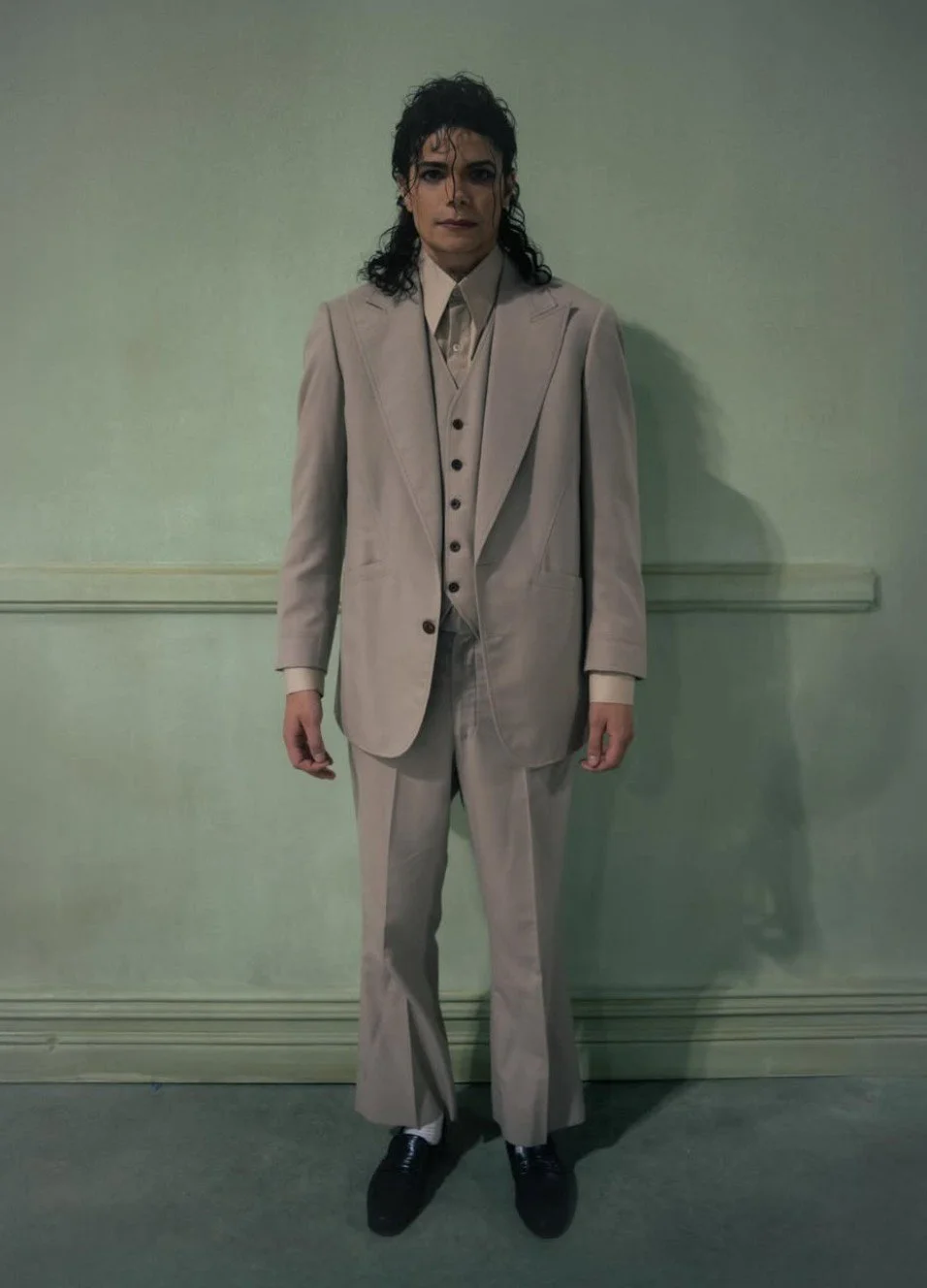
Fabio Jackson, Michael Jackson impersonator, placed deliberately at the back of the room.
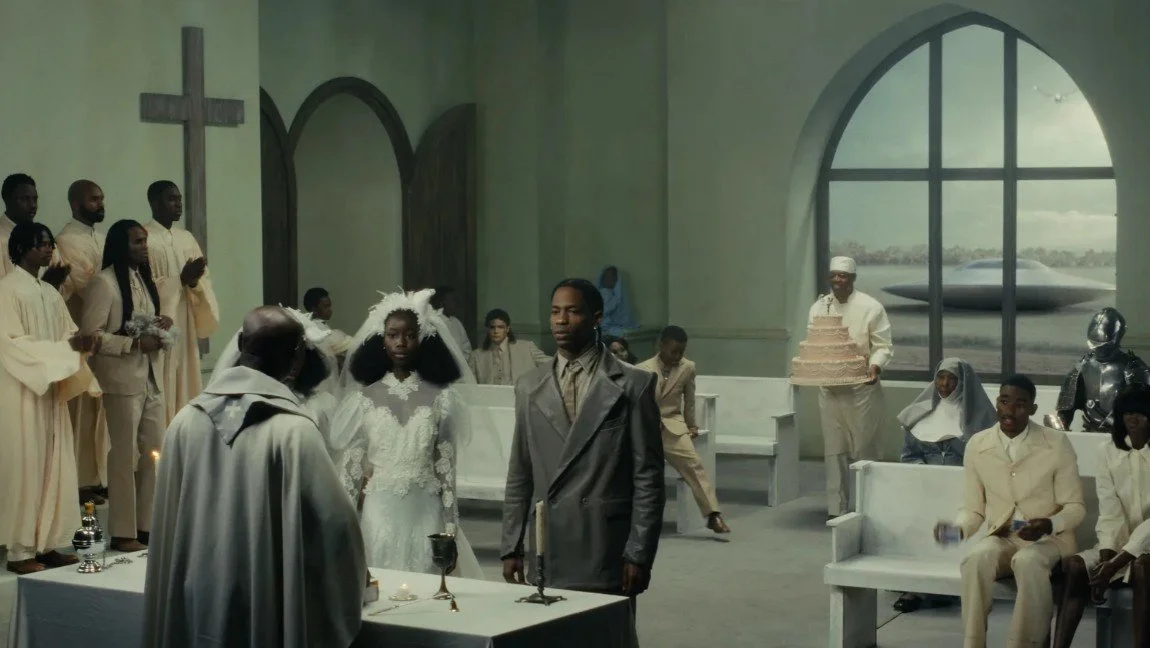
Travis Scott performs his verse. Two brides stand beside him. Nobody flinches.
The album is called “Bully.” Ye has spent the better part of a decade bullying himself out of cultural relevance. The title is either deeply self-aware or deeply not. Probably both.
But here is what matters for this piece: Ye gave Censori the frame and she built a world inside it. That is the more interesting creative transaction. Most artist-spouse collaborations are vanity projects dressed as partnership. This one produced something cinematically coherent and conceptually dense enough to stand without his name attached. You could watch "Father" knowing nothing about Kanye West and find it formally striking, symbolically layered, and culturally precise. That is a meaningful threshold.
You could watch "Father" knowing nothing about Kanye West and find it formally striking, symbolically layered, and culturally precise. That is a meaningful threshold.
For three years, the images of Bianca Censori circulated as a particular kind of cultural shorthand. Barely dressed. Provocative. Controlled. A body deployed in service of someone else's image. The art world watched and stayed mostly quiet. The fashion press catalogued the outfits. The tabloids filled in the rest.
What those images never managed to capture, because images rarely do, was what she was actually thinking. Now there is a three-minute answer, and it is unexpectedly rigorous. She was thinking about space. About ritual. About what it means to construct an environment that holds multiple truths at once without resolving any of them. About what it means to be faithful in a world that rewards spectacle. About the figures history has always placed at the back of the room — the innocent, the extraordinary, the inconvenient — and what it costs them to stay there.
Bio Pop was the proof of concept. "Father" is the first film. If there is a third act, it will not be as anyone's wife.
The body never left the room. It just stepped behind the camera.
The readings offered here are the writer's own — "Father" has not been annotated by Censori, West, Scott, or anyone involved in its making, and individual interpretations are, as ever in art, entirely the audience's to decide.